
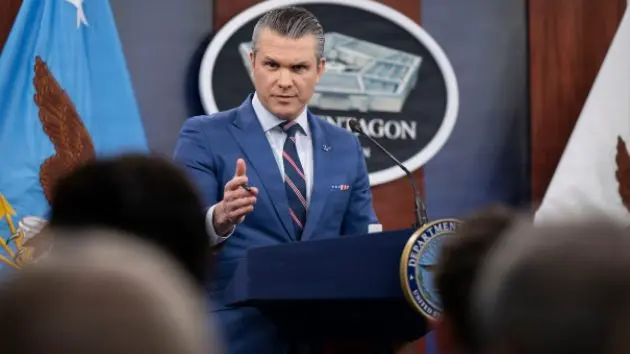
(WASHINGTON) — Defense Secretary Pete Hegseth on Tuesday said the U.S. will end its war with Iran “on our timeline” and “at our choosing” amid mixed messaging from the administration on the timing of the operation and its ultimate objective.
Hegseth notably declined to give a further assessment on how much longer the military campaign will last, saying Tuesday would be the most intense day of strikes yet in the 11-day conflict and that it will be up to President Donald Trump to decide when the war is over.
“The president has set a very specific mission to accomplish, and our job is to unrelentingly deliver that,” Hegseth told reporters at a Pentagon press briefing.
“Now he gets to control the throttle. He’s the one deciding. He’s the one elected on behalf of the American people when we’re achieving those objectives. And so, it’s not for me to posit whether it’s the beginning, the middle or the end. That’s his. And he’ll continue to communicate that,” the defense secretary said.
Trump himself has made conflicting statements on the matter.
Trump told CBS News on Monday afternoon that the war is “very complete, pretty much.” But around that time, the Defense Department’s rapid response social media account posted on X: “We have Only Just Begun to Fight.”
ABC News White House Correspondent Selina Wang pressed Trump later Monday evening at a news conference: “So, which is it and how long should Americans be preparing for this war to last for?”
“Well, I think you can say both. The beginning — it’s the beginning of building a new country, but they certainly, they have no navy, they have no air force, they have no anti-aircraft equipment,” Trump said.
“We could call it a tremendous success right now. As we leave here, I could call it. Or we could go further and we’re going to go further,” the president added.
Trump said on Monday he thinks the war will be over “very soon” and repeatedly called the war a “short-term excursion.”
Trump and his top officials have outlined four objectives of the military offensive: destroy Iran’s ballistic missile capabilities; annihilate their Navy; ensure they can never obtain a nuclear weapon; and prevent the Iranian regime from arming and funding terrorism outside its borders. But broader goals on what comes after the fighting ends remains unclear.
Trump’s signaled he could declare the military campaign a success at any time, even as the Iranian regime remains in power and Iran still maintains its enriched uranium stockpile. Trump’s repeatedly said Iran cannot be allowed to obtain a nuclear weapon — and over the weekend said he was not ruling out the possible use of U.S. ground troops in Iran, but said that they would be used only “for a very good reason.”
The president has also sent mixed messages on regime change, and how involved the U.S. intends to be in what new leadership will take control in Tehran.
Trump expressed disappointment in the selection of Mojtaba Khamenei, the 56-year-old son of Ayatollah Ali Khamenei, who was killed in a U.S.-Israeli strike at the beginning of the war.
In a phone interview with ABC News Chief White House Correspondent Mary Bruce on Sunday, Trump said the new leader is “going to have to get approval from us.”
“If he doesn’t get approval from us he’s not going to last long. We want to make sure that we don’t have to go back every 10 years, when you don’t have a president like me that’s not going to do it,” Trump told ABC.
Hegseth, though, on Tuesday vowed the U.S. would not be involved in “mission creep.”
“This is not endless. It’s not protracted,” Hegseth said.
“This is not 2003. This is not endless nation-building … Those days are dead. Instead, we’re winning decisively with brutal efficiency, total air dominance, and an unbreakable will to accomplish the president’s objectives,” Hegseth said.
Copyright © 2026, ABC Audio. All rights reserved.