
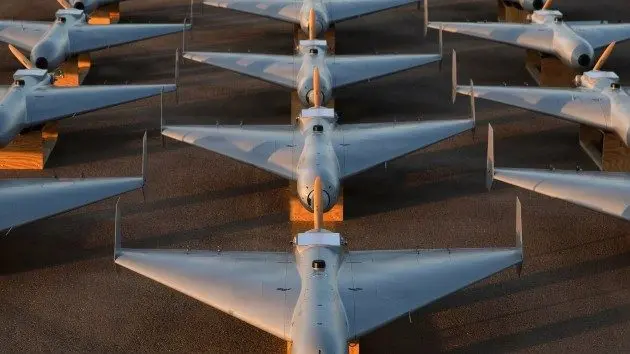
(WASHINGTON) — The U.S. military has deployed its first squadron of one-way attack drones to the Middle East, employing a U.S.-built drone that was reverse-engineered from Iran’s Shahed drones that have been used by Iran against Israel and by Russia against Ukraine.
U.S. Central Command (CENTCOM) announced on Wednesday the establishment of Task Force Scorpion Strike (TFSS) that will oversee the first of its kind operational deployment by the U.S. military.
The employment of the new one-way drones is an indication of how low-cost drone technology has changed the battlefield in the wake of the war in Ukraine and the war between Israel and Iran.
A common thread in both those conflicts is Iran’s one-way Shahed drones, capable of carrying explosives over long distances. Used by Iran to target Israel, Russia has purchased large quantities of them to launch large swarm attacks against Ukraine.
The Low-cost Unmanned Combat Attack System (LUCAS) drones, built by SpektreWorks, that CENTCOM has deployed to the Middle East are based off the reverse engineering of a delta-winged Shahed-136 drone obtained by the U.S. several years ago, according to a Department of Defense official.
At a cost of $35,000 each, the drones are an improvement on the Iranian drone and a more effective military option at a much lower price point than the deployment of manned fighter aircraft, the official said.
Able to travel long distances, the LUCAS drone is also designed to operate autonomously and can be launched from catapults, rocket-assisted takeoff, and mobile ground and vehicle systems.
The new drones will be sent to various locations in the Middle East, said the official, who declined to provide information as to how many of the drones were being deployed to the region.
Interestingly, the drone squadron does not belong to one of the military services but will be operated by a joint special operation unit operating under CENTCOM.
“This new task force sets the conditions for using innovation as a deterrent,” said Adm. Brad Cooper, CENTCOM commander. “Equipping our skilled warfighters faster with cutting-edge drone capabilities showcases U.S. military innovation and strength, which deters bad actors.”
Israel’s attack on Iran in November severely disabled Iran’s sophisticated missile air defense systems, making it much less able to counter against any air threats, including one-way drone attack, the official said.
“We are essentially flipping the script” on Iran said the official, who noted that the new drone system is a more effective deterrent because there is less risk about its potential use as an offensive capability than if manned aircraft were to be used.
The system’s deployment was spurred in part by Defense Secretary Pete Hegseth’s “drone dominance” initiative that accelerates the delivery of low-cost and effective drones to U.S. forces.
Copyright © 2025, ABC Audio. All rights reserved.