
This is a companion to WSJM’s updated primer on the Kinexus inquiry, published today.
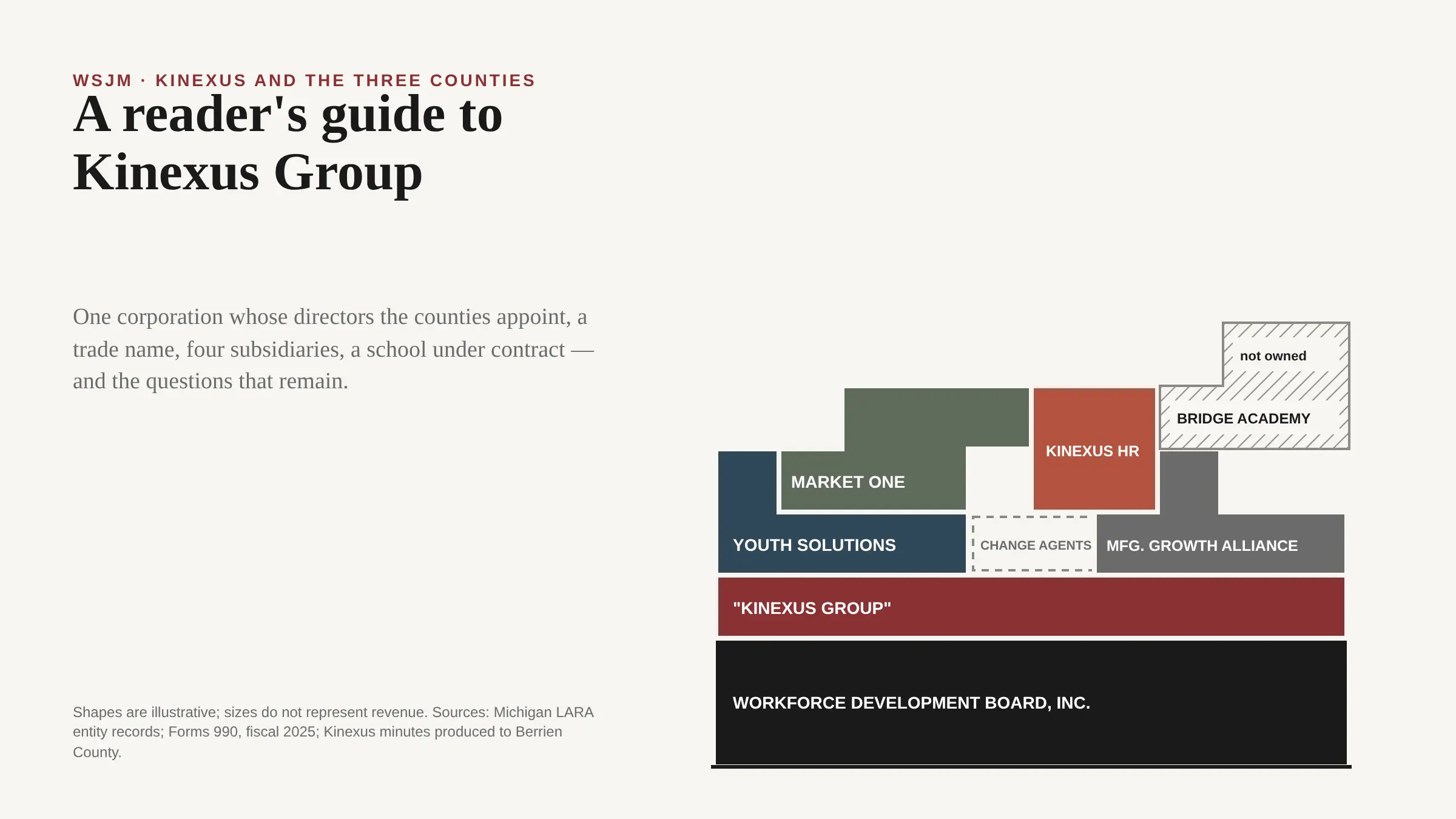
The name on the door says Kinexus Group. The name on the deeds, the tax returns, and the state’s corporate register says Berrien-Cass-Van Buren Workforce Development Board, Inc. This is a guide to the organization at the center of the counties’ inquiry: what it is, what it controls, who is in charge, and the questions the records raise that no one has yet answered.
The entity
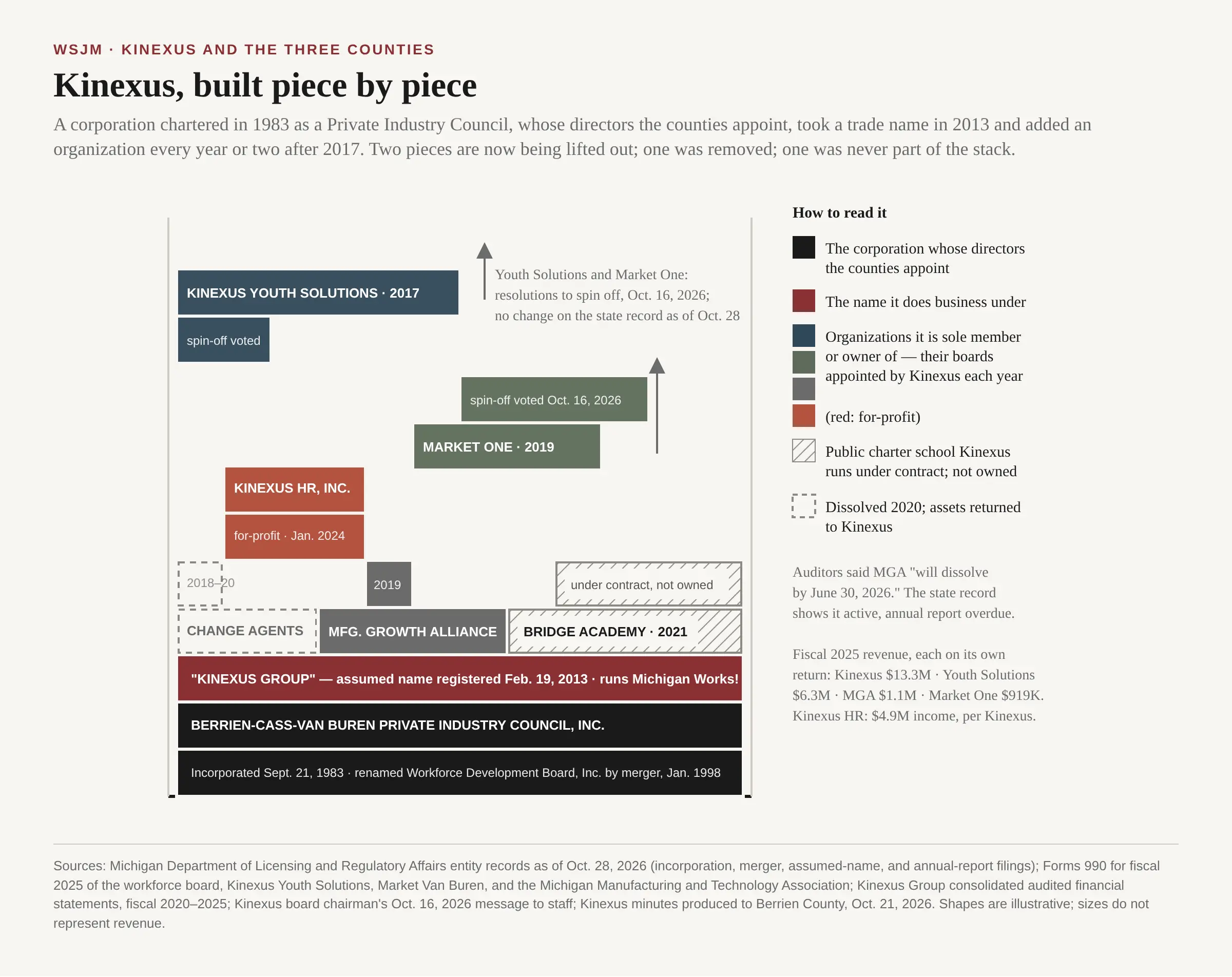
There is no corporation named Kinexus Group. The organization is the Berrien-Cass-Van Buren Workforce Development Board, Inc., a Michigan nonprofit incorporated on Sept. 21, 1983, as the Berrien-Cass-Van Buren Private Industry Council, according to state corporate records. A second corporation carrying the workforce board’s name was formed in December 1995; the two merged in January 1998, and the 1983 corporation took the name it has today. “Kinexus Group” is an assumed name it registered with the state on Feb. 19, 2013; “Michigan Works Berrien Cass Van Buren” is another, registered in 2002. The organization’s own website says “Kinexus Group formed” in 2018. Nothing on the state record was formed that year.
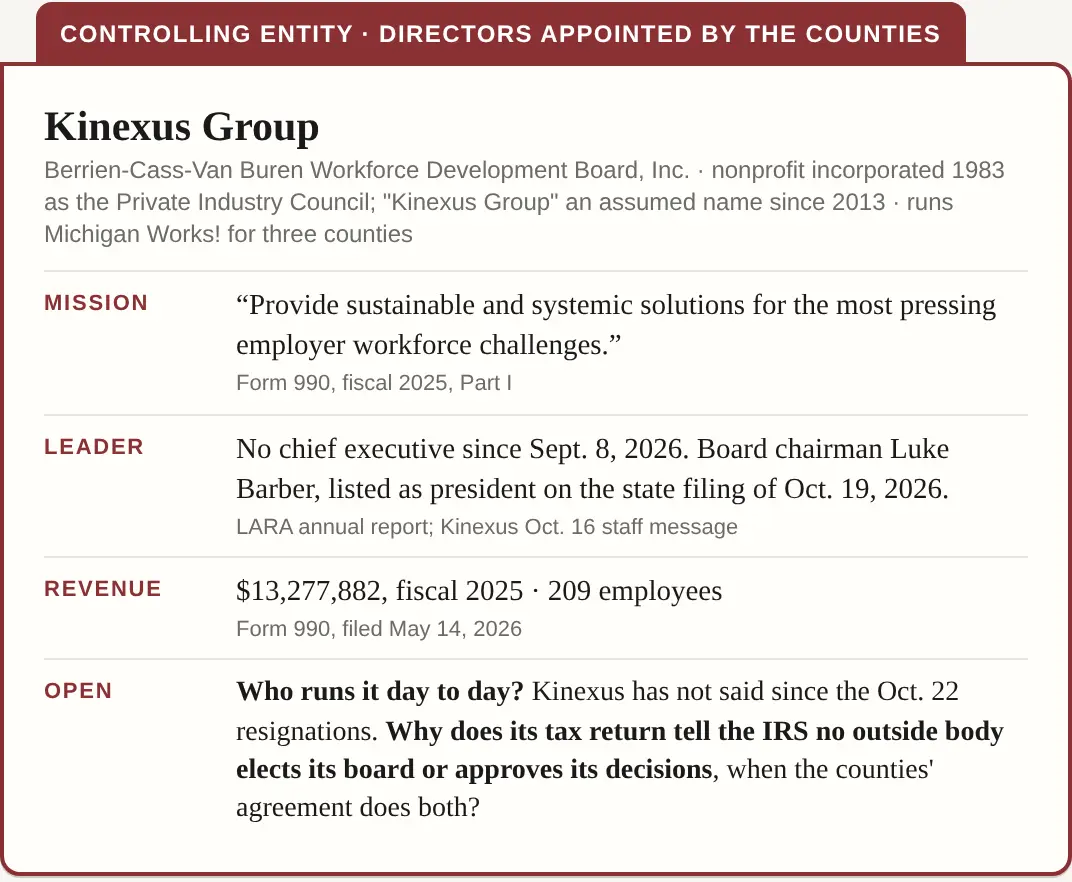
The distinction matters because every obligation follows the corporation, whatever name it uses. The 2000 agreement among the three counties, the bylaws the counties ratified in 2015, the 2005 offer letter to its chief executive, and the security agreement pledging its pandemic tax credit were all signed by the same corporation. Under the agreement, the county boards of commissioners appoint every director, no bylaw amendment takes effect until all three county boards ratify it, and the counties jointly carry the liability for any public money the federal government later disallows.
Its most recent federal tax return, for the year ending June 30, 2025, filed May 14, 2026, reports 21 voting directors, 209 employees, $13,277,882 in revenue, and 11 people paid more than $100,000. Asked on that return whether any person or body outside the board has the power to elect its directors, or whether any of its decisions are subject to approval by anyone other than the board, the organization answered “No” to both.
What it controls
Kinexus is the sole member or owner of four other organizations and runs a fifth, a public school, under contract. The Kinexus board appoints each affiliate’s directors every year, and Kinexus managers sit on each affiliate board, according to its minutes. Kinexus also charges the affiliates for administration: under a formula its investment committee adopted in February 2026, each pays 5 percent of its revenue plus 10 percent of its payroll.
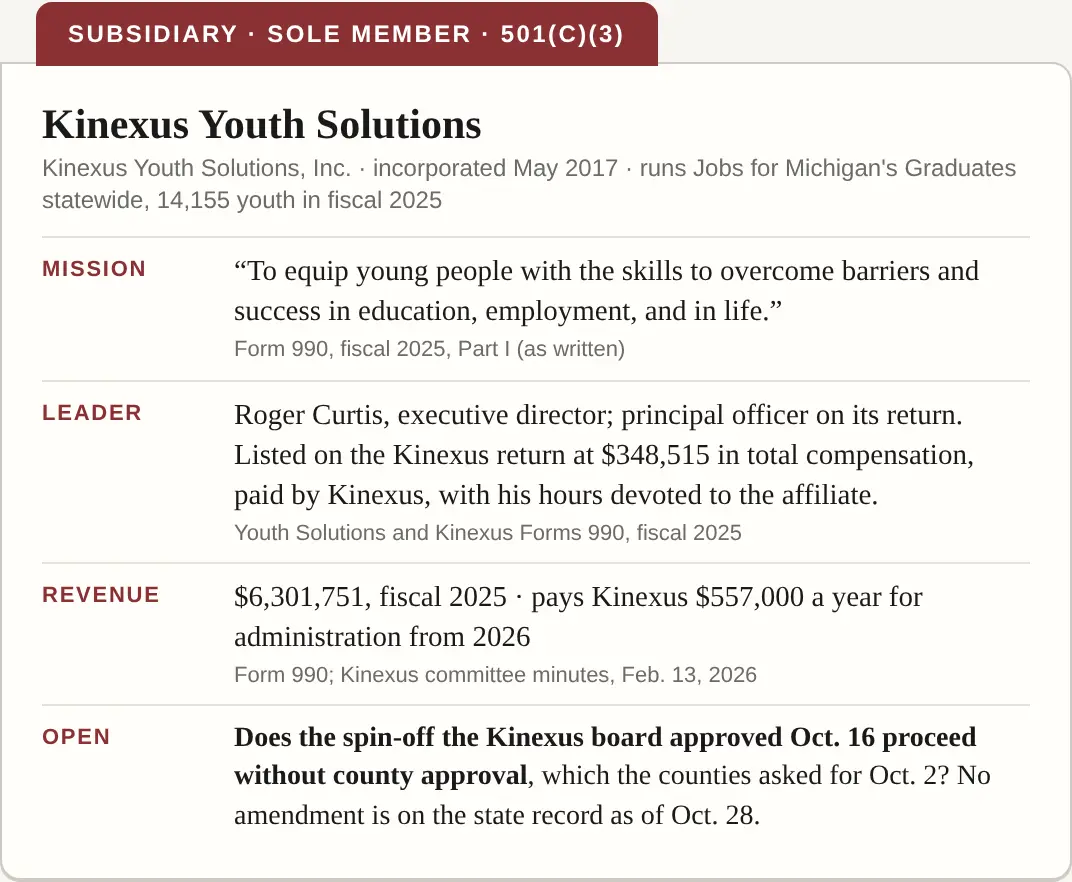
Kinexus Youth Solutions, a 501(c)(3) incorporated in May 2017, runs Jobs for Michigan’s Graduates statewide and is the largest affiliate, with $6.3 million in revenue in fiscal 2025 on its own return. Its executive director, Roger Curtis, is the highest-paid person listed on the Kinexus return, at $348,515 in total compensation; the return reports his compensation as paid by Kinexus and his hours as devoted to the affiliate. Youth Solutions paid Kinexus $456,648 for administration in fiscal 2023 and $579,915 in fiscal 2024; the figure for the coming year under the new formula is $557,000, according to Kinexus’s minutes.
Market Van Buren, which operates as Market One, is an economic development nonprofit incorporated in August 2019, with $919,000 in revenue in fiscal 2025. Its administrative charge from Kinexus rises from $50,000 to $134,974 under the formula. Van Buren County Board Chairman Kurt Doroh, who sits on its board, said in September that its separation from Kinexus “was in the works” before the counties’ inquiry began and that it had chosen the Southwest Michigan Regional Chamber as its new parent. Dan Peat, its interim executive director, signed its most recent tax return. Four Kinexus directors — board chairman Luke Barber, Doroh, Tom Stanek, and Arnie Redsicker — also sit on Market One’s board, according to its 2026 state filing.
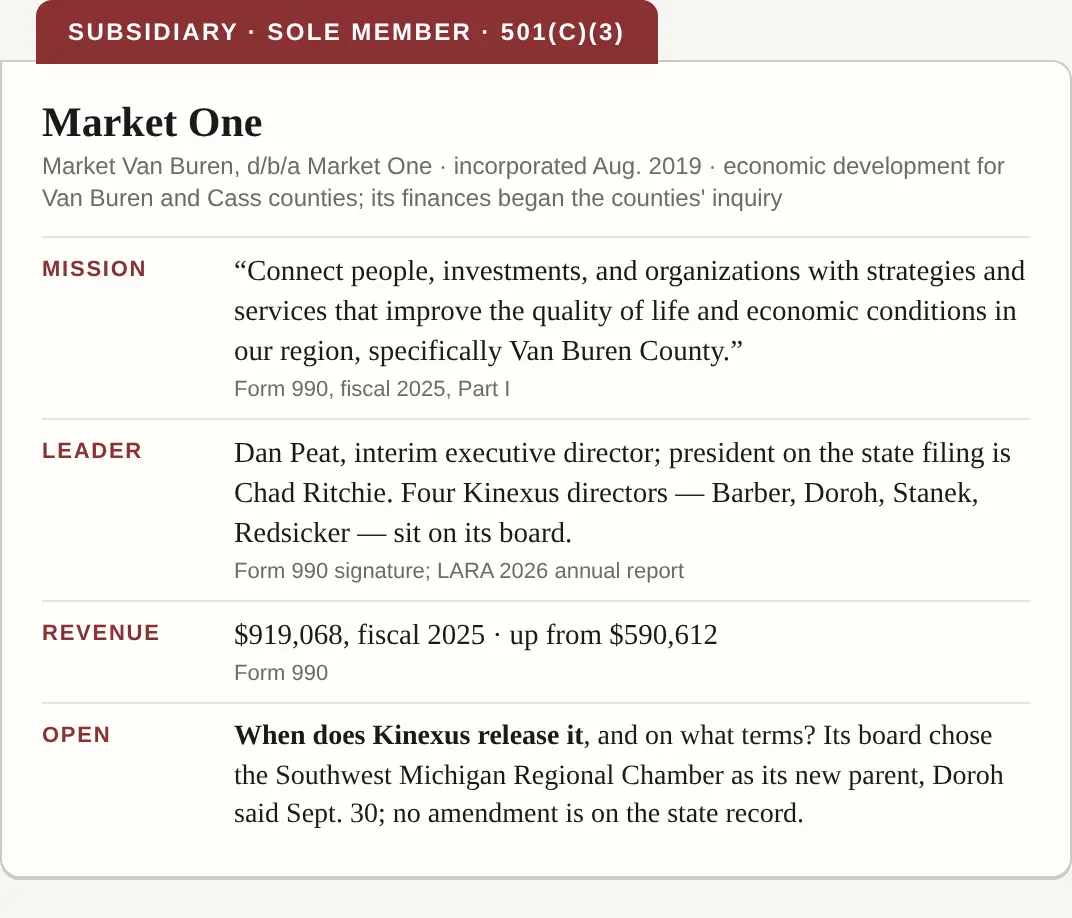
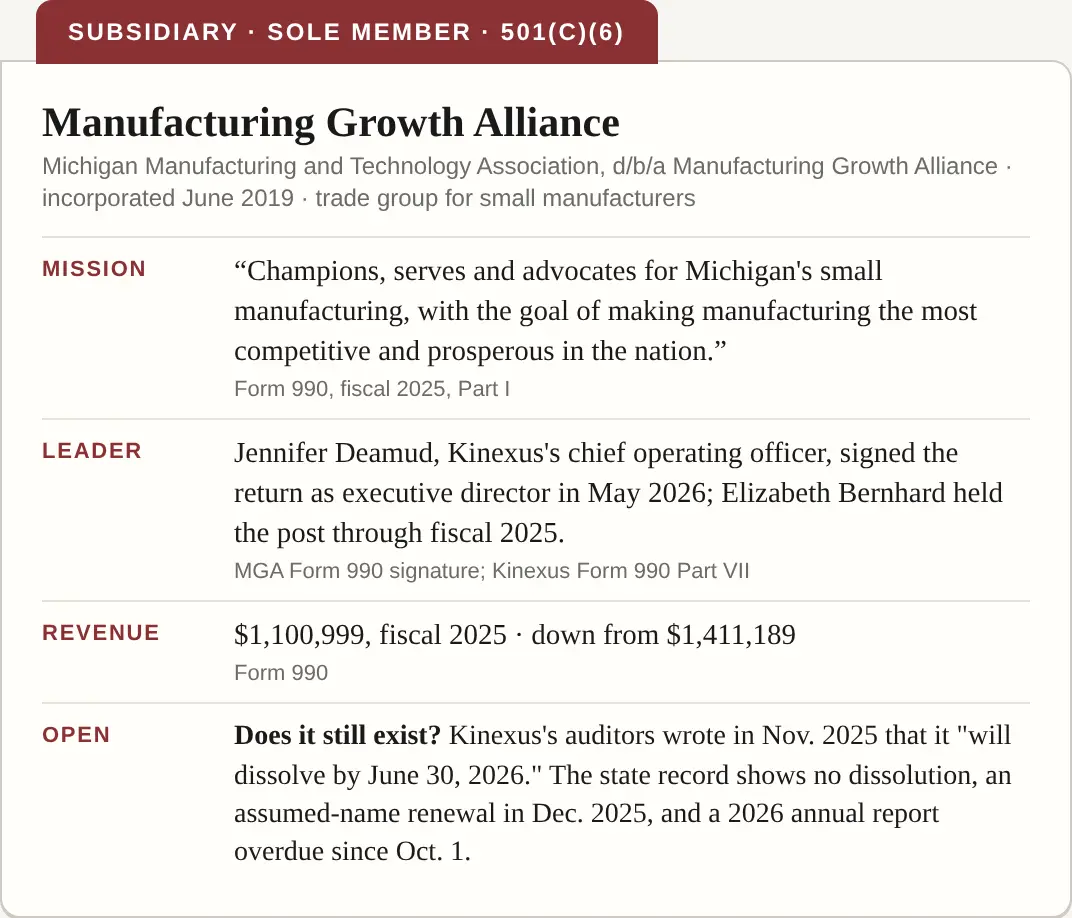
Manufacturing Growth Alliance, legally the Michigan Manufacturing and Technology Association, is a 501(c)(6) trade group incorporated in June 2019, with $1.1 million in revenue in fiscal 2025, down from $1.4 million the year before. Kinexus’s auditors wrote in November 2025 that “MGA will dissolve by June 30, 2026.” It has not. The state record shows no dissolution, a renewal of its assumed name filed Dec. 2, 2025, and an annual report due Oct. 1 that had not been filed as of Oct. 28. Jennifer Deamud, Kinexus’s chief operating officer, signed the alliance’s most recent tax return as its executive director in May; the Kinexus return lists Elizabeth Bernhard as its executive director through June 2025.
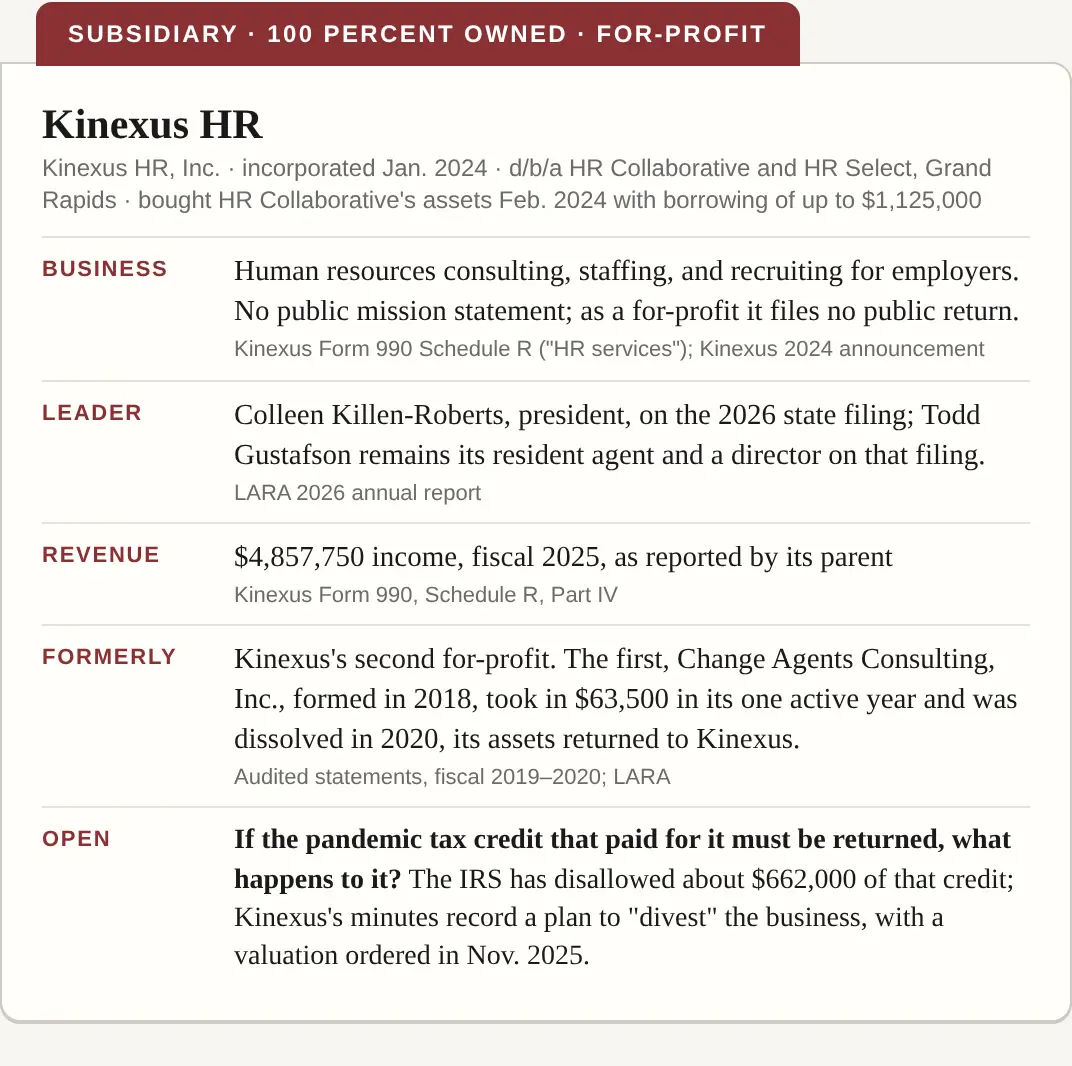
Kinexus HR, Inc., which does business as HR Collaborative, is a for-profit corporation the Kinexus board voted to create in December 2023 and incorporated in January 2024. It bought the assets of HR Collaborative, a Grand Rapids human resources consultancy, in February 2024, with borrowing of up to $1,125,000. Kinexus reports owning 100 percent of it, with $4,857,750 in income and $1,655,505 in assets in fiscal 2025. Berrien County Corporate Counsel Thaddeus Hackworth told the counties’ committee the business “was purchased largely with the funds that came back from” the Employee Retention Credit, the pandemic-era refund whose treatment the counties and the state have questioned and part of which the IRS has disallowed. Kinexus’s minutes from July 2025 record a plan “to divest in HRC and have it grow,” and a valuation firm was engaged in November 2025. On the company’s most recent annual report to the state, filed before his departure, Todd Gustafson, the chief executive who left Kinexus Sept. 8, is listed as its resident agent and a director; no change has been filed since. It is the second for-profit Kinexus has formed. The first, Change Agents Consulting, Inc., incorporated in 2018, took in $63,500 in its one active year and was dissolved in 2020, its assets returned to Kinexus.
Bridge Academy of Southwest Michigan is different. It is a public charter school authorized by Central Michigan University; Kinexus is its educational service provider and the employer of record for its staff, under what Kinexus’s chief financial officer called a “Total Responsibility Contract.” Kinexus’s minutes describe the school as “under the umbrella of Kinexus Group,” and Kinexus’s own cost allocation plan lists it as a related party, but Kinexus does not own it and does not report it as a related organization on its tax return.
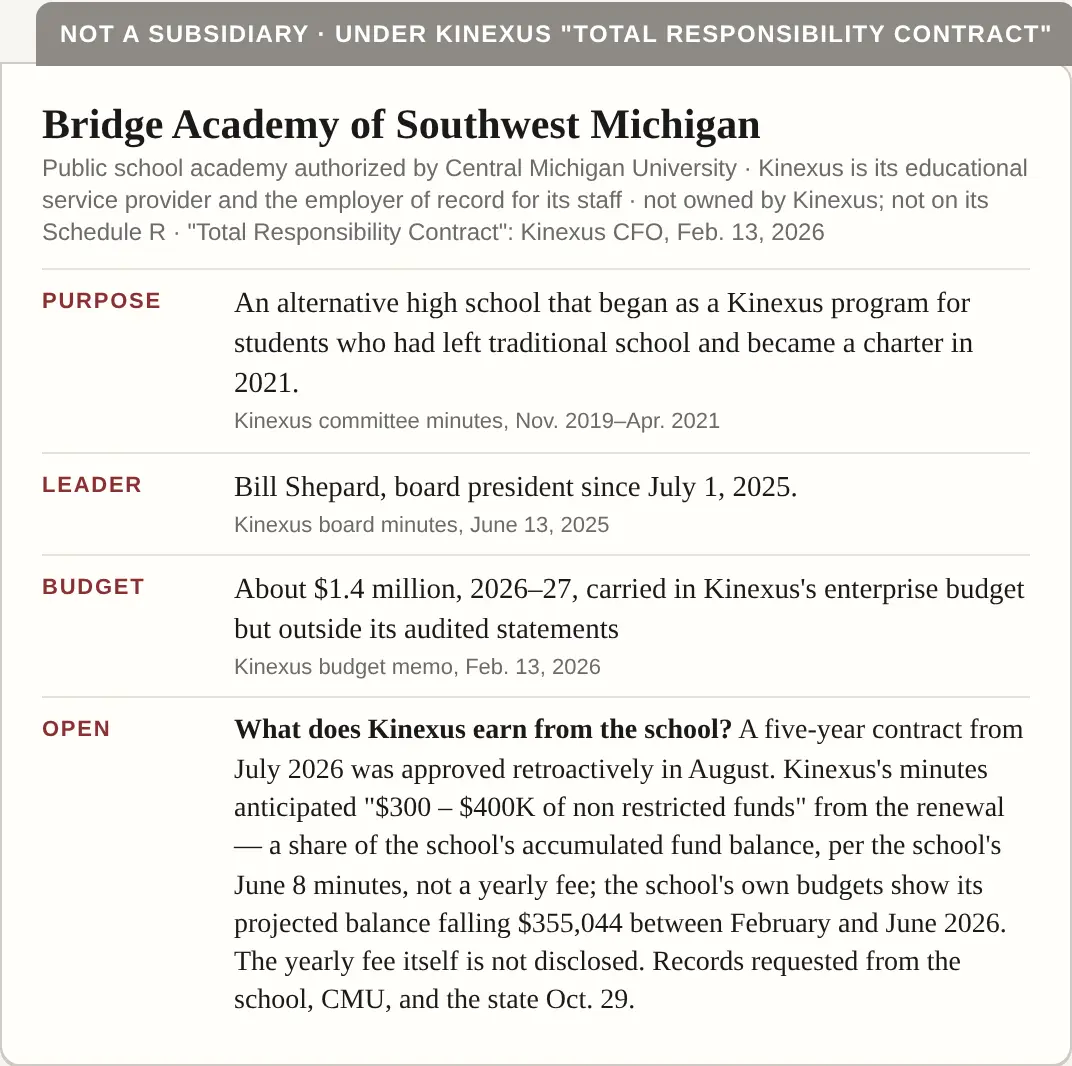
Kinexus received 65 to 72 percent of every dollar Bridge Academy spent in each of the last four years, according to the school’s check registers; the school’s audit discloses a management fee of $25,000, and the school’s state expenditure reports show about $407,000 of administrative functions billed through Kinexus in fiscal 2025. In August, Kinexus’s executive committee approved a five-year service agreement with the school, running from July 1, 2026, retroactively. A February minute entry anticipated that the renewal “may” bring Kinexus “between $300 – $400K of non restricted funds.” The school’s own minutes show what that is: a share of the school’s accumulated reserves, which the school’s board agreed on June 8 to divide, keeping an amount equal to 20 percent of its revenue. Between February and June, the school’s projected fund balance fell by $355,044.
Kinexus sets the administrative fees that the organizations it controls pay it. The one it does not own — a public school — pays Kinexus the largest share of its budget, under terms that have not been made public. The school’s own staff, whom Kinexus employs, are part of what Kinexus bills, and Kinexus’s audits through 2023 show the arrangement as cost reimbursement with no margin.
On Oct. 16, the Kinexus board passed resolutions to begin spinning off both Youth Solutions and Market One. “This has been the plan all along,” Barber wrote to staff that day. “Kinexus Group has served as an incubator for these organizations.” Two weeks earlier, the counties’ joint committee had asked the board in writing to agree that, “apart from the Market One separation,” no affiliate would be spun off without county approval. The records WSJM has reviewed contain no county approval of the Youth Solutions spin-off, and as of Oct. 28 neither affiliate had filed anything with the state to remove Kinexus as its sole member.
Who runs it
Three bodies govern the corporation on paper: the board of directors, whose 21 members the counties appoint; the Chief Elected Officials Board, made up of county commissioners, which under the agreement must approve the executive’s contract and the budget; and a Corporate Executive Committee of a few directors that, the records show, set the chief executive’s pay and approved the deferred-compensation plan.
Luke Barber, a Van Buren County appointee, became chairman at the board’s Oct. 16 annual meeting; the corporation’s annual report to the state, filed three days later, lists him as president, Marla Schneider, the president and CEO of Cornerstone Alliance, as secretary, and Dorothy Munao as treasurer, with 13 other directors. On Sept. 9 he had written to the board that he would not stand for the post, that the “current organizational and governance dynamics require leadership with experience navigating this particular landscape,” and that his priority “needs to return to my business.” Barber succeeded George Saleeby, who signed every one of the chief executive’s expense reports from August 2022 on. Arnie Redsicker, who signed the 2000 agreement as the board’s chairman, returned to the board this month as a Van Buren appointee.
On the staff side, the chief executive of 21 years, Todd Gustafson, left Sept. 8. Erin Wright, the chief people officer Kinexus had announced as interim leader, Mary Johns (formerly Morphey), the chief marketing officer, and Josh Cosner, the chief information officer, resigned Oct. 22. The executives who remain on the most recent tax return are Jennifer Deamud, the chief operating officer, and Coleen Frens-Rossman, the chief financial officer. Kinexus has not answered WSJM’s question of who is leading the organization day to day; the state has said that in the absence of a director, the workforce board itself is responsible.
For the counties, the inquiry is led by Julie Wuerfel, the Berrien County commissioner who chairs the Chief Elected Officials Board and whose questions about Market One began it; Roseann Marchetti of Cass County and Kurt Doroh of Van Buren, who co-chair the joint committee with her; and Hackworth, who is drafting the replacement agreement. For the state, Stephanie Beckhorn, who heads the workforce office at the Michigan Department of Labor and Economic Opportunity, led the Oct. 29 session with the counties. Kinexus has been represented by two outside attorneys, Mark Rizik of Miller Johnson and Brian Strauss. A search committee has offered the interim executive director’s job to Michelle Zieziula; she has not accepted.
What is still unanswered
Since July, WSJM has put written questions to Kinexus before each report that drew on its records or described its conduct, and has published its responses as they arrived. On Aug. 18 the agency wrote that it would be “more productive for us to work directly with the counties.” It has since answered one set of WSJM’s questions in writing, on Oct. 8; confirmed some facts in replies on Oct. 17 and Oct. 27; and on Oct. 23 asked for more time to answer questions about its chief executive’s expenses, which it has not yet done. Where a question below has been put in writing to Kinexus, the date is given; none of these has been answered. The three that arise from records WSJM reviewed this week — the tax return’s control answers, the status of Manufacturing Growth Alliance, and the charter school’s price and reserves — rest on public filings and on Kinexus’s own minutes and are stated here as the records show them.
Who is in charge. Kinexus has not said who holds the Michigan Works! director’s functions since Oct. 22. (Asked of Kinexus, Oct. 27.)
Whether the counties have a say over the affiliates. The agreement, Hackworth has said, requires no county approval to create or dispose of an affiliate. The counties asked for one anyway on Oct. 2; the board voted to spin off two affiliates two weeks later, with four of its directors also sitting on the board of one of them. Whether the Youth Solutions spin-off proceeds without county approval, and on what terms, is open.
Whether the money that bought Kinexus HR has to be repaid. The IRS has disallowed about $662,000 of the Employee Retention Credit, and the state has asked what salaries supported the claim. If the credit must be returned, the for-profit bought with it is the asset the counties’ lawyer has said should not be sold first — and its state filing still names the departed chief executive as its agent and a director. (Asked of Kinexus by the counties and the state, Sept. 25 and Oct. 9.)
What the deferred-compensation plan is owed. Ten executives were enrolled in a retention plan approved by the executive committee in 2022; three of them have now resigned, and the plan’s 2023 awards vested Dec. 12, 2025. Hackworth is to report Nov. 9 on whether the counties could be liable. Kinexus’s tax returns for both 2024 and 2025 answer “No” to whether any listed officer participates in such a plan. (Asked of Kinexus, Oct. 21.)
What the tax return says about control. The 2025 return tells the IRS that no one outside the board elects its directors or approves its decisions; the counties’ agreement says otherwise. It describes the three nonprofit affiliates as not controlled by Kinexus, while Kinexus’s own minutes say Kinexus appoints their boards every year. It lists a law firm, a government-relations firm, and an accounting firm among its “grants,” without explanation. And it reports 21 directors, where the corporation’s October filing with the state names 16.
What became of Manufacturing Growth Alliance. The auditors said it would dissolve by June 30; the state says it exists, late on its annual report, with Kinexus’s chief operating officer signing as its executive director.
What Kinexus is paid to run the charter school, and whose money the reserves were. The yearly price of the service agreement is not public; the renewal was approved retroactively; and the school’s board agreed in June to divide its reserves, which are public school money, with Kinexus under the renewal. WSJM has requested the contracts and the fund-balance terms from the school, its authorizer, and the state. (FOIA requests sent Oct. 29.)
Whether the 2000 agreement was ever filed. The state could find no record that it was, and the counties are drafting a new one rather than resolve the question. (Reported Oct. 9.)
—
A note on methods: This report draws on the organization’s audited financial statements, its federal tax returns and those of its affiliates, Michigan corporate records, its board and committee minutes produced to Berrien County, its governing documents, the charter school’s published budgets and minutes, records of the three counties and the state, and WSJM’s recordings of public meetings, all previously reported in this series. WSJM used artificial intelligence tools to assist in searching, organizing, and cross-referencing those records and in preparing working analyses of them. Consistent with Associated Press guidance, WSJM treats AI output as unvetted source material: every fact that appears in this report was verified by WSJM journalists against the original documents, all interviews and editorial decisions are human, and responsibility for the reporting rests entirely with the WSJM newsroom. Errors, when identified, are corrected and disclosed.