
The story at a glance:
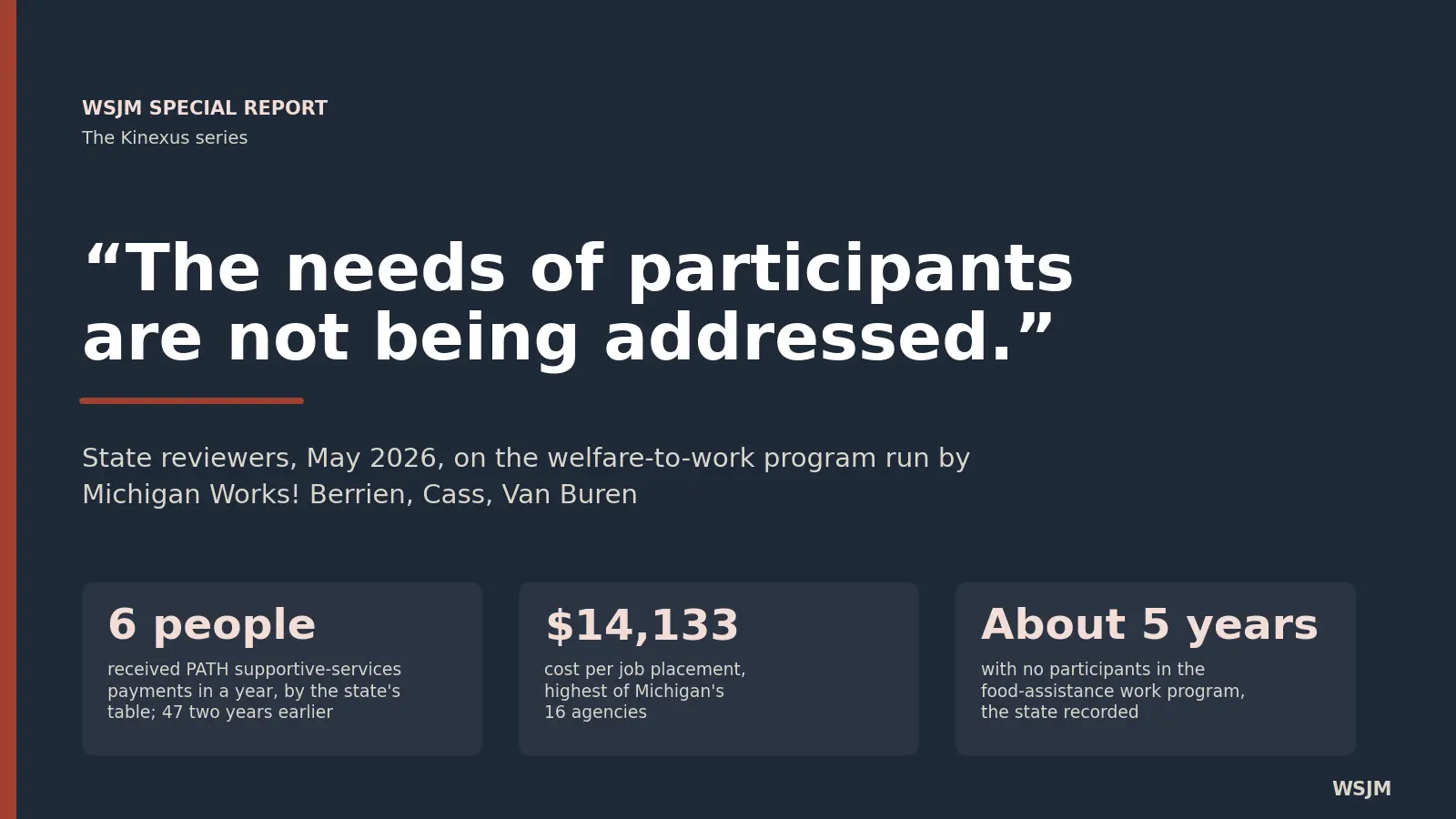
- State reviewers who visited Kinexus Group’s welfare-to-work program in May 2026 wrote “the needs of participants are not being addressed” and staff were reluctant to spend the money set aside to remove obstacles to work, such as car repairs and license fees.
- In the agency’s food-assistance work program, the reviewers found most participants placed in unpaid “workfare” assignments the agency said it preferred because they were “easier to track.” The state told WSJM on Friday that practice “is not consistent with state policy.”
- The state ranks the program’s cost per job placement, $14,133, highest among Michigan’s 16 Michigan Works! agencies for the first nine months of fiscal 2026.
- Kinexus disputes none of the findings. It says payments once took “several months,” are now expected within 30 days, and that it has spent $40,892 on PATH participants through a separate program since May 2024.
Why it matters: These are the services the three counties’ workforce board exists to deliver to the residents with the fewest options, and the state’s own reviewers, and the agency’s own monitor, describe them as falling short at the same time the counties are deciding what replaces the board.
State reviewers who examined Kinexus Group’s welfare-to-work program this spring wrote that participants’ needs were “not being addressed,” that agency staff were reluctant to spend money meant to help people overcome obstacles to work, and that in a second program, for food-assistance recipients, most participants were placed in unpaid work assignments the agency said it preferred because they required fewer hours and were easier to track. That program, state records show, had no participants at all for roughly five years prior.
The findings are in site-visit reports the Michigan Department of Labor and Economic Opportunity produced to WSJM under the state Freedom of Information Act. The state’s files also include two internal monitoring reports written by the agency’s own quality-assurance manager, which describe many of the same problems in the agency’s own words.
Kinexus Group operates Michigan Works! Berrien, Cass, Van Buren, which serves the three counties, whose boards of commissioners are separately examining the organization’s finances and governance. Earlier reports in this series have examined how the organization is governed, how its executives are paid, a 2023 state review of its case records, and, this week, the state’s finding that the board’s structure has a “structural defect.” A guide to the series is here.
This report turns to the services themselves, drawing on state reviewers’ own accounts of two programs Kinexus runs for residents who receive cash assistance or food assistance. Those programs are part of what the agency does, not the whole of it. The state’s worksheet lists Kinexus’s PATH awards for fiscal 2025 at about $1.8 million, against total revenue of $13.3 million the workforce board reported on its most recent federal tax return; the larger federal workforce programs Kinexus also administers are not the subject of the May reports. The food-assistance program is smaller still, with a program award of $59,507 this fiscal year.
The programs are small in dollars but not in people. The state’s own count shows 783 referrals to Kinexus’s PATH program in the first nine months of fiscal 2026 and 160 participants, 150 of whom attended an activity.
“The needs of participants are not being addressed”
PATH is Michigan’s work program for families receiving cash assistance. Local agencies, including Kinexus, receive a separate allocation for supportive services, which help participants with practical obstacles to working. Kinexus told state reviewers the most common uses are driver’s licenses and ID cards, car repairs and insurance, travel reimbursement, and household expenses such as rent and utilities.
The state’s figures, reproduced in the report on a May 11–12, 2026 site visit the department conducted for Berrien County, show Kinexus spent $854.94 on those supportive services for PATH participants in the year ending March 12, 2026. According to the report’s table, eight payments went to six people. None of that program’s supportive-services money went to car insurance, car repairs, vehicle purchases, mileage, or public transportation.
The same state table for the year ending Feb. 26, 2024 shows $18,903.19 spent on 47 people, including two vehicle purchases, three car-insurance payments, and 36 payments for public transportation.
A separate financial worksheet the state coordinator completed for the same May visit, drawn from the agency’s expenditure reports, lists the fiscal 2026 supportive-services award at $11,233 with 10 percent unspent as of March 31. The records do not reconcile the two figures.
Asked to explain the difference, the department told WSJM the reviewers’ table covers the 12 months ending March 12, 2026, while the worksheet covers the first two quarters of fiscal 2026, Oct. 1, 2025 through March 31, 2026, and that “the figures in the coordinator’s worksheet more accurately represent the agency’s supportive services spending.” The department did not say why the two figures, which cover overlapping periods, differ. Kinexus, asked the same question, did not explain the difference; it noted that the program year runs from Oct. 1 through Sept. 30 and that March 12, 2026, “is in the middle of the program year.”
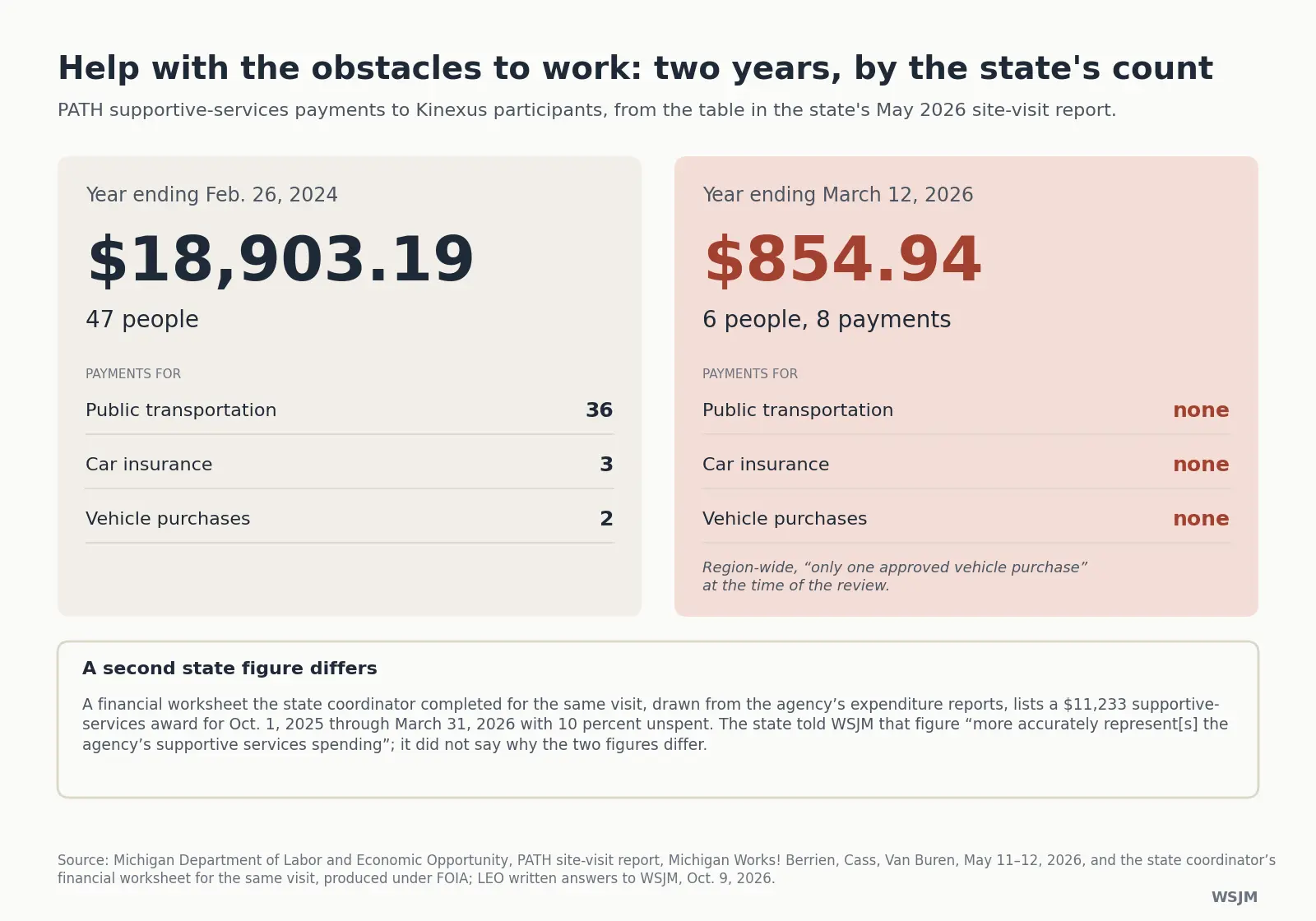
PATH supportive-services payments to Kinexus participants, from the table in the state’s May 2026 site-visit report, with the state coordinator’s differing worksheet figure.
In the report, which refers to the agency by the state’s abbreviation for Berrien-Cass-Van Buren, the reviewers wrote:
“At the time of the review, the entire BCVB region only had one approved vehicle purchase. These types of support services are typically offered if an individual inquires or requests them. With transportation being such a huge barrier, the needs of participants are not being addressed. Staff indicated reluctance to promote, use or spend funding due to the internal process of issuing funds (turnaround time can take up to 30 days).”
The state recommended “a new process that can issue funds in a more efficient and timely manner,” noting that “other Michigan Works! locations are issuing funds within days, but no longer than five days.”
In written answers to WSJM on Thursday, agency officials did not dispute the state’s findings. They said that after the review the agency “reinforced” with its PATH staff “the importance of identifying participants’ needs and removing employment barriers.”
“…there was a time when payment of supportive service payments at times took several months due to funding sources being delayed or not in the Michigan Works! request system, which caused a delay in participants getting barriers removed.” — Kinexus Group officials.
The process has been changed, the agency said, and payment “is expected to be completed within 30 days,” with the finance department expediting urgent requests and credit cards “recently activated” for critical needs. Asked how many participants requested supportive services in the year the state examined, and how many requests were approved or denied, the agency did not provide numbers, saying denials “are rare.”
Kinexus has told the state it pays for some of these needs another way. A state reviewer’s notes from an August 2025 visit record that the agency “has been utilizing BRES funding for supportive services,” referring to Barrier Removal Employment Success, a separate program the state also reviews. During that August 2025 visit, the state reviewed three of the agency’s case files from that program and documented a $5,000 vehicle purchase in each. The records WSJM obtained do not show the program’s total spending. Kinexus told WSJM that “PATH supportive service expenditures alone do not capture all financial assistance provided to PATH participants,” and that since May 2024 it has provided $40,892 in supportive services to PATH participants through that program.
The reviewers also found that of 15 PATH case files they examined, four had participants’ service plans kept up to date as required; the rest had at least one section that had not been updated in a year. At an orientation session the reviewers observed, participants were told that job-search logs could be used to verify their work hours until a pay stub arrived. The report says “this practice does not align with PATH policy,” and that the state coordinator provided the agency the manual’s rules on acceptable documentation of employment hours.
Workfare, “easier to track”
The same May 2026 visit produced a separate report on the Food Assistance Employment and Training program, or FAE&T, which the state describes in its review materials as voluntary. Its activities can count toward a work requirement that applies to some food-assistance recipients. The report notes that the “Time-limited Food Assistance (TLFA) waiver expired in this region December 1, 2025.”
Under the state’s food-assistance policy, adults 18 through 64 without dependents under 14 can receive benefits for only three months in a three-year period unless they work or take part in a qualifying activity at least 80 hours a month; that limit had been waived here, and since Dec. 1 it applies in Berrien, Cass, and Van Buren counties, as it does in most of Michigan. The program’s activities are one way to meet it. Participants reach the program by referral, and few referrals become participants: the state’s count for the first nine months of fiscal 2026 shows 13,305 referrals to the Kinexus program and 324 participants, 308 of whom attended an activity.
One of those activities is workfare, an unpaid work assignment. In Kinexus’s own description to the state, a participant “must have a commitment from an employer or nonprofit organization” to take one, and the agency counted “more than 60 organizations” where participants could be placed, naming food pantries, a Head Start program, Goodwill, a Habitat for Humanity ReStore, a humane society, local libraries, and churches “providing non-religious duties such as janitorial and office work.” The number of hours owed each month is the household’s food-assistance benefit divided by the state minimum wage, according to an explanation from the Michigan Department of Health and Human Services that state reviewers passed along to the agency earlier this year.
All six case files the reviewers examined had at least one problem, such as an outdated assessment, missing documentation of hours, or a case not closed on time. The agency had issued no supportive-services funds for any of the six. Most had been placed in workfare, and the report records why: the agency “stated assignment to this activity was preferred as it requires less hours and is easier to track.”
The reviewers wrote that “there were some cases that indicated individuals were interested in pursuing other activities that helped them meet the TLFA work requirement but were directed to Workfare as there is a lower hour requirement,” and that “there is a lack of job readiness activities and engagement to evaluate the job readiness of individuals.” They advised the agency to tell participants about other options and let them choose. The agency told the reviewers it now has a virtual academy and Google certification programs, and plans new job-readiness workshops.
Asked whether the practice the reviewers described is consistent with the program’s rules, the department told WSJM on Friday that it was not.
“The [Kinexus described] practice is not consistent with state policy for the Food Assistance Employment and Training (FAE&T) program.” It said it provided technical assistance to the agency “indicating customers should be assigned to activities based on their interest in participating in the program and career goals.” – Michigan LEO officials.
In its answers to WSJM, Kinexus officials described the preference for workfare as the participants’ own.
“Many of the participants prefer workfare because it generally requires fewer hours, while the participant balances education, family, and searching for employment,” — Kinexus officials.
Agency officials added that case managers “have been reminded to balance participant preferences with the program’s objective of helping participants obtain employment.”
The six participants whose files the state reviewed “did not need supportive services requiring financial assistance at that time,” the agency said, and its March questionnaire answer “described the agency’s ability to meet supportive service needs across the program; it did not indicate that every participant received financial assistance.”
In a questionnaire it completed for that review, revised March 12, 2026, Kinexus answered the state’s question of whether it was able to provide supportive services as needed: “Yes, BCVB Michigan Works! has been able to provide needed supportive services.” The state reviewers’ financial worksheet for the program shows its supportive-services allocation 100 percent unspent for fiscal 2025, and 100 percent unspent for fiscal 2026 as of March 31.
The worksheet and the agency’s answer agree on that much: no money was spent. They differ from the state’s reviewers on why. The agency says the six participants did not need financial help; the reviewers, who examined the same files, recorded that none received it, that some who wanted other activities “were directed to Workfare,” and that the agency should tell participants their options. The agency’s larger PATH supportive-services allocation went entirely unspent in fiscal 2023 and two-thirds unspent in fiscal 2025, the same worksheets show.
Five years without a participant
The food-assistance work program had been dormant at Kinexus for years before that. A state worksheet from a February 2024 review states that the agency “has not had a participant for FAE&T since 2020,” and the reviewer wrote that Kinexus “did not have a case file available for review.” At an August 2025 review, the state recorded “zero participants” and noted “this area has not had any participants in approximately 5 years.”
The agency had not submitted an internal monitoring report for the program, did not provide documentation of annual civil-rights training, and was not using current program forms, the state’s worksheet records. State expenditure records on the same worksheets show the agency’s program allocation entirely unspent for fiscal 2023, 56 percent unspent for fiscal 2024, and entirely unspent for fiscal 2025 as of that visit. The reviewer’s follow-up notes record that the state and the Department of Health and Human Services “engaged roundtable discussions on possible ways to increase participation in the program.”
The program was small across Michigan in those years: the state’s tables show seven of the 16 Michigan Works! agencies, including Kinexus, with no one leaving the program in either fiscal 2024 or fiscal 2025. After the waiver expired in December 2025, participation rose statewide.
At Kinexus it rose sharply. The state’s data through June 30 show 277 people leaving the program in the first nine months of fiscal 2026, 13 of them to employment, a 4.7 percent rate against 6.1 percent statewide. The state’s worksheet lists the agency’s program award at $17,000 for fiscal 2025, 83 percent of it unspent, and $59,507 for fiscal 2026, recorded as fully spent by March 31, halfway through the fiscal year. The fiscal 2025 award had started at $33,505, the department told WSJM; part of it “was recaptured and redistributed to other agencies” under state policy. The program’s separate supportive-services allocation — money for the transportation help, ID fees, work permits, and clothing that Kinexus told the state its participants most often request — was untouched in both years.
What the agency’s own monitors found
According to internal monitoring reports included in the state’s files, Kinexus’s quality-assurance manager reviewed 16 PATH files in June 2025 and wrote that “there is no evidence of one-on-one or group workshops of job readiness” and that “case notes in the reviewed files did not tell a comprehensive story with solid follow-up.” The report recommended a mandatory four-day job-readiness workshop.
The same manager reviewed 14 food-assistance program files in March 2026. That report found two-thirds of the files lacked an assessment and none of the participants had received supportive services; nearly all had chosen workfare, and most “failed to meet participation requirements and were exited.” It noted that participants were required to find their own workfare sites and that “most of the participants never turned in their WorkFare agreement paperwork.”
That same month, in an email a state reviewer wrote was “not meant to create a sense of disciplinary action,” the state asked agency staff about a PATH participant who had been assigned the same activities for nearly two years. The agency’s written answer: “We have not offered any workshops within the service center in the past few years.”
Asked when it last offered job-readiness workshops before that and what it has offered since, Kinexus told WSJM it launched an online training portal in February 2026 covering communication, professionalism, time management, teamwork, and job applications, developed “due to low in-person attendance resulting from transportation and childcare barriers.” It said it also offers monthly financial-literacy instruction with Honor Credit Union, hosts three named workshops on durable skills, résumés, and interviewing “twice a month, allowing for in-person and virtual attendance,” and has sessions scheduled in October, November, and December. It did not say when workshops were last offered before March 2026 or when the twice-monthly sessions began.
What happened next
In response to what it found, the state recommended and offered two trainings for the agency’s PATH staff, on removing participants’ barriers to work and on handling non-compliance, and delivered both virtually on June 26. The department sent both May reports to then-chief executive Todd Gustafson on Aug. 4, requesting follow-up information and “confirmation of compliance.” Gustafson’s departure was announced 13 days later. Kinexus told WSJM it “did not submit a formal response to LEO’s August 4 transmittal because the agency understood that the identified items had been addressed before the report was issued,” and that “accordingly, there is no formal response to provide.” It said it had corrected the PATH case files the report identified and was using updated food-assistance program forms the state provided. The department, asked whether the agency had responded, said on Friday: “Yes, the agency did respond. All follow-up items are considered resolved.” It did not say in what form.
A separate review turned up a second problem. The agency’s own internal data-validation check of its federal workforce programs for the program year that ended June 30, 2026 showed, in the department’s words, “an overall 50% pass rate,” against the 80 percent state policy requires; the department’s own April 2025 review of the agency’s federal workforce programs had passed it at 85 percent. Under the state’s policy, agencies below 80 percent “are subject to technical assistance training and/or corrective action, as determined by LEO.” The department delivered that training at the agency’s offices on Oct. 1, and said the session also covered “training needs identified by the Michigan Works! Agency”; Kinexus described the same session as held at its request, for new case managers and program managers and “a refresher for experienced staff.” “No further corrective action is required at this time,” the department said.
Asked who is responsible for the agency’s response to the state’s findings and for the programs’ day-to-day administration with no executive director in place, Kinexus said its executive vice president of workforce, Jennifer Deamud, oversees both. Three career development specialist positions serve the PATH and food-assistance programs and a third program across the three counties, the agency said; two are filled, one is vacant, and none has been hired since June 1. It said it recently hired a program manager to support the programs.
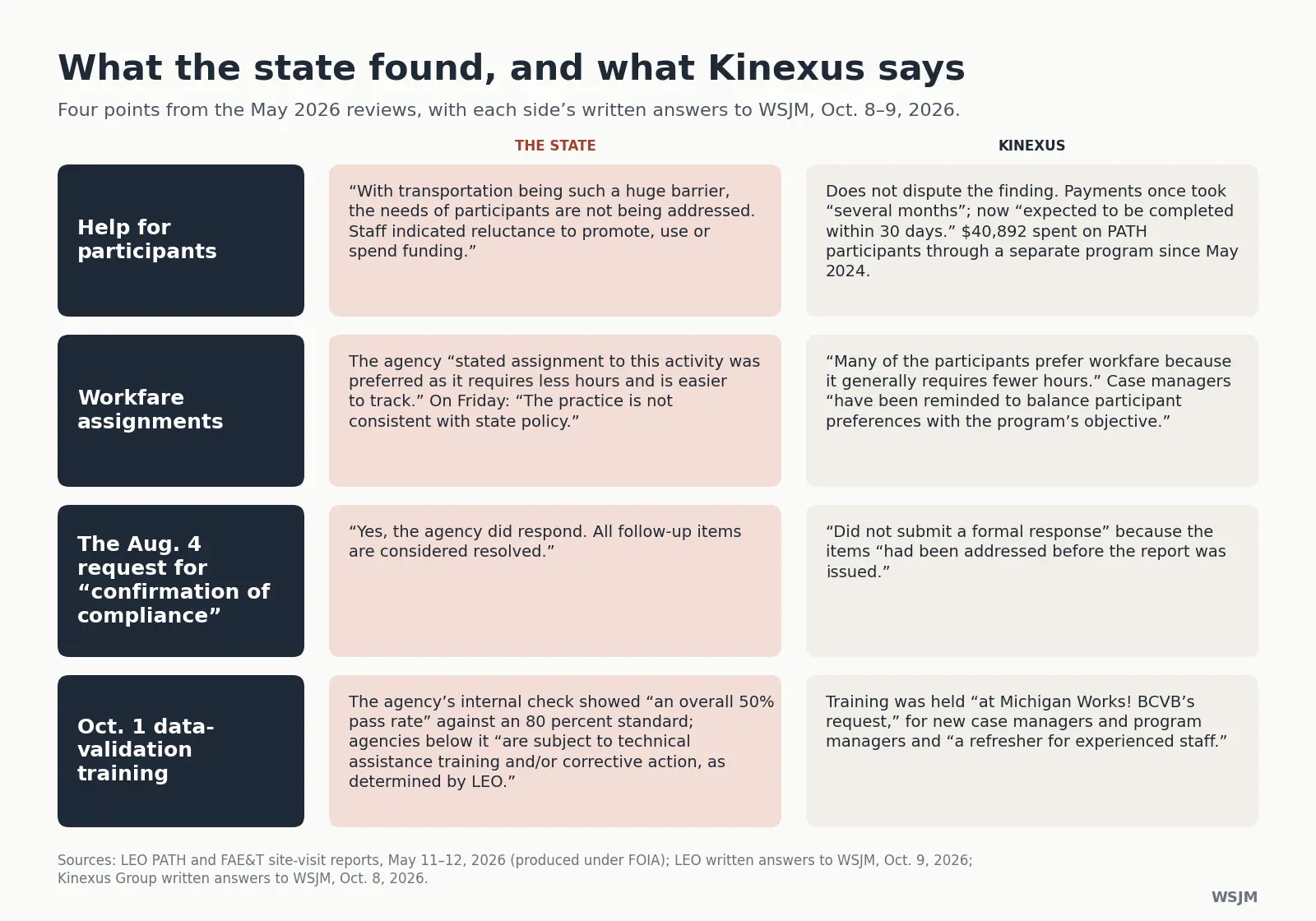
Four points from the May 2026 reviews, with each side’s written answers to WSJM, Oct. 8–9, 2026.
The reports are program reviews, not financial audits, and they identify no questioned costs. The department’s separate fiscal reviews of the agency from February 2024 through February 2026, also in the records, produced 10 findings across five visits, most of them small: a $12.28 late fee charged to federal funds, a $1,000 postage bill and a $4,691 electrical bill charged as program rather than administrative costs, a subrecipient employee’s conflict-of-interest form last signed in 2021, a closeout report filed three months late, federal cash drawn ahead of need, expenses booked in the wrong period, 22 cents of sales tax, and a $649.07 technology invoice charged to both a program pool and the one-stop center’s cost-sharing agreement, which the state put “in question” and the agency corrected. The state accepted the agency’s responses and closed every finding. In its April 2025 review of the agency’s federal workforce programs, 34 of 40 files, or 85 percent, passed the department’s data-validation check, above the 80 percent passing mark.
Highest cost per job placement
The state’s own rankings put the PATH program’s cost per job placement — spending, excluding supportive services, divided by participants who found full-time work — at $14,133 for the first nine months of fiscal 2026, against a statewide figure of $6,352. That was the highest of Michigan’s 16 Michigan Works! agencies. The agency ranked 14th in each of the two prior years. With 80 placements in that period, small changes in the count can move the figure substantially.
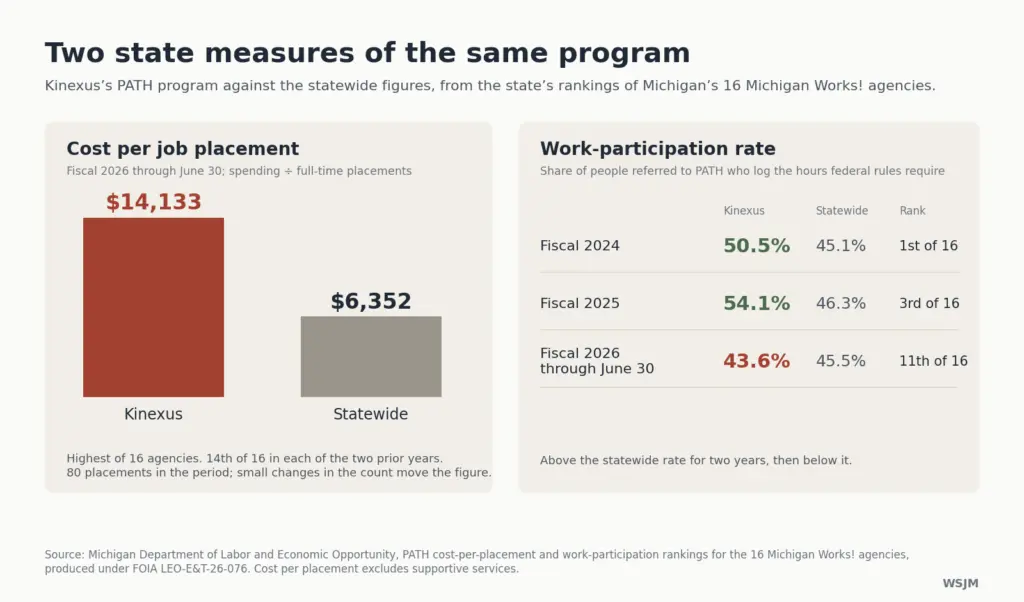
Kinexus’s PATH cost per job placement and work-participation rate against the statewide figures, from the state’s rankings of Michigan’s 16 Michigan Works! agencies.
The records offer some explanation of the number without settling it. The figure is a ratio: every dollar the program spends on staff, space, and outreach, divided by the number of people who leave for full-time work. Kinexus told WSJM its PATH spending “includes staff time, supportive services, leased space, technology, and other operating costs,” and that much of the work happens before a person is counted as a participant at all, during a two-week eligibility period the agency helps referrals complete, which “require[s] significant effort across our rural communities.”
The state’s data show a program with a large front end: referrals outnumber enrolled participants nearly five to one, and in fiscal 2024 and 2025 its participants logged required hours at above the statewide rate. Placements, the figure’s denominator, numbered 80 in nine months. The reviewers’ findings on job-readiness workshops and case files describe the program’s practices in the same period; the records do not say whether they explain the cost.
Other measures in the same state reports placed the agency above the statewide figures in fiscal 2024 and 2025. On the work-participation rate, which tracks the share of people referred to PATH who log the hours federal rules require, Kinexus ranked first of the 16 agencies in fiscal 2024 at 50.5 percent and third in fiscal 2025 at 54.1 percent, against statewide rates of 45.1 and 46.3 percent. For fiscal 2026 through June it stood at 43.6 percent, below the statewide 45.5 percent and 11th of 16. On the federal performance measures for the agency’s adult, dislocated-worker, and youth programs, the state’s reports show Kinexus below its negotiated targets on several indicators in the last two program years, including four of five adult measures in 2024.
Those targets are set in negotiation between each agency and the state, and missing one is not itself a violation: under the state’s rules, corrective action follows only when an agency’s overall score falls below 90 percent of its targets or a single measure falls below half. On the adult measures it missed in 2024, Kinexus’s results were about 90 percent of its targets, and it was above the corrective-action line in every program.
The state’s quarterly reports also track a third PATH measure: the share of participants starting activities who have an assessment score recorded in the state’s data system. Kinexus’s rate fell from 55.2 percent in fiscal 2024 to 38.3 percent in fiscal 2025 and 36.9 percent in fiscal 2026 through June, 48 of 130 participants, while the statewide rate rose from 73.2 to 80.0 to 81.9 percent. Only two of the other 15 agencies had lower rates in each of the first two years, and only one in the third. WSJM did not put the figure to the agency; its own quality-assurance manager cited the state’s table in June 2025, writing that “only 47% of O’Net assessments are entered in OSMIS,” and recommended that staff “Enter the results of the O’Net in OSMIS,” in the same internal report that found no evidence of job-readiness workshops.
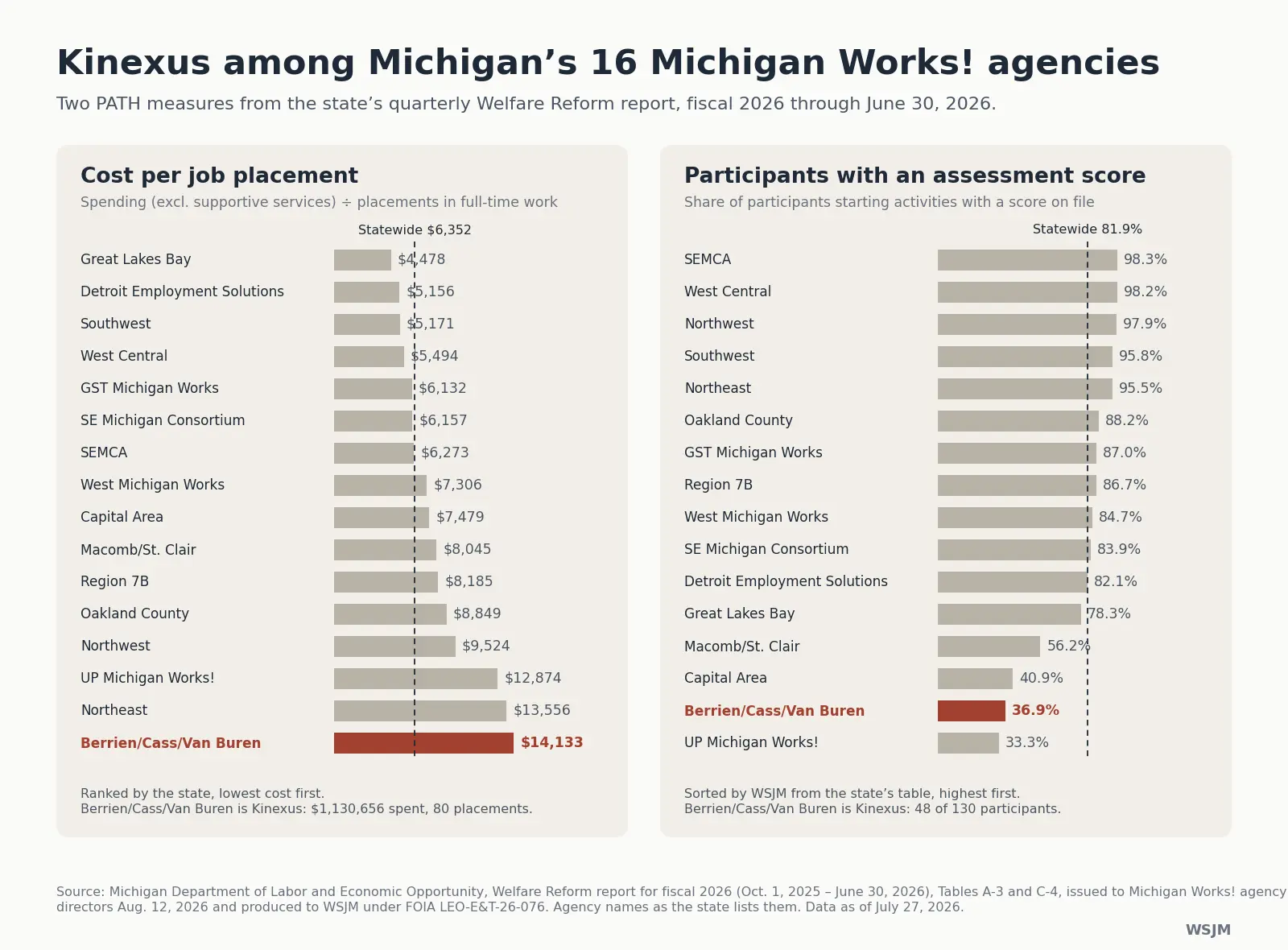
Cost per job placement and share of participants with an assessment score, fiscal 2026 through June 30, from the state’s quarterly Welfare Reform report.
The staff who deliver these programs are not the subject of the state’s reports, nor of this report. In February 2024, state reviewers recorded that the agency’s career development staff and leadership team “expressed their staff turn over as a barrier to being productive and moving forward,” and the agency told the state in August that it had hired many new employees over the summer.
Where the counties’ review stands
The three counties’ examination of Kinexus is separate from the state’s monitoring and has not, so far, concerned the programs described here. A joint committee of Berrien, Cass, and Van Buren county representatives met for the first time Sept. 30 in Cassopolis and accepted the premise its lawyer put in front of it: a new public workforce development board has to be created, whatever ends up operating under it. Berrien County Corporate Counsel Thaddeus Hackworth told the committee that the agency has no executive director and no interim one, and that the state had not answered, 16 days after he asked, whether the current structure complies with federal and state workforce law.
The state answered on Oct. 7, in a letter Hackworth provided to WSJM: “a structural defect does currently exist with respect to the local area,” the department wrote, and it “must be addressed through the entry of the three counties into a new interlocal or intergovernmental agreement.” (Read that report here.) Gustafson’s departure took effect Sept. 8; the Kinexus board has named no successor, and a committee it created Sept. 1 is to search for one. The counties’ committee meets again Oct. 16 in St. Joseph, after the Kinexus board’s annual meeting that morning.
—
A note on methods: This series draws on thousands of pages of records — board minutes, audits, tax returns, and governing documents. WSJM used artificial intelligence tools to assist in searching, organizing, and cross-referencing those records and in preparing working analyses of them. Consistent with Associated Press guidance, WSJM treats AI output as unvetted source material: every fact that appears in these reports was verified by WSJM journalists against the original documents, all interviews and editorial decisions are human, and responsibility for the reporting rests entirely with the WSJM newsroom. Errors, when identified, are corrected and disclosed.