
The county officials charged with deciding what to do about Kinexus Group opened their work Wednesday by accepting the premise their lawyer put in front of them: a new public workforce development board has to be created, whatever ends up operating under it.
They received an overview of three ways to do that, took research assignments, set a second meeting for Oct. 16, and, on a motion from Van Buren County, voted that they do not oppose Market One’s plan to separate from Kinexus.
Along the way, Berrien County Corporate Counsel Thaddeus Hackworth told them that the agency has no executive director and no interim one, that he cannot say who is making its daily decisions, and that the state has not answered, 16 days after he asked, whether the structure it describes complies with federal and state workforce law.
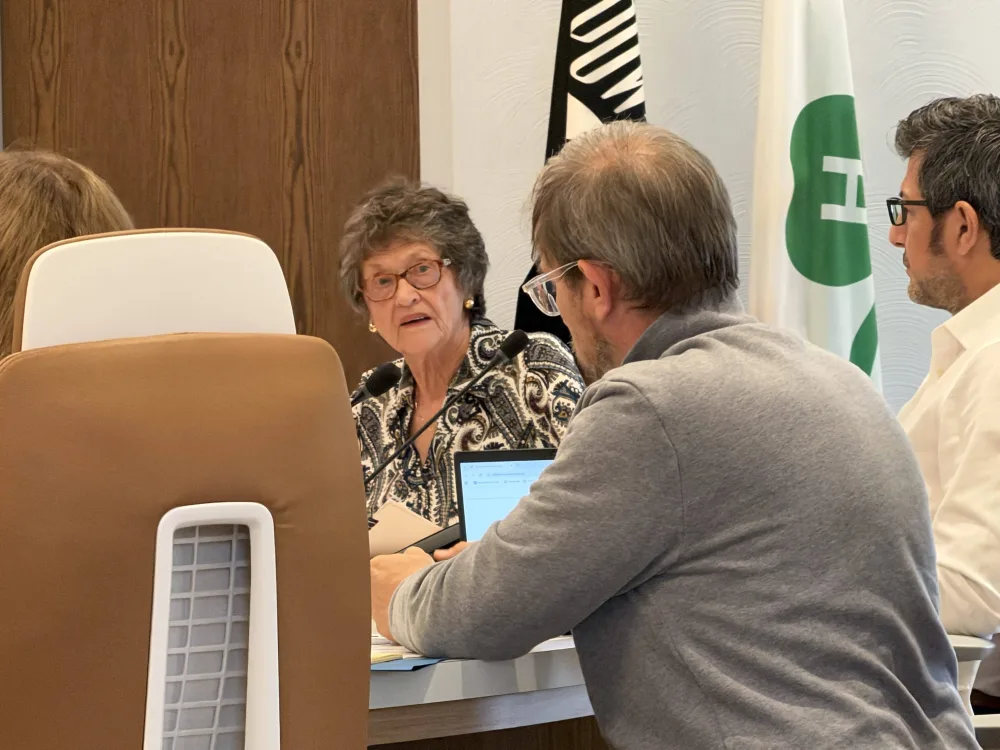
The Berrien-Cass-Van Buren Counties Joint Ad Hoc Committee, 10 representatives that the three county boards designated to take up Hackworth’s Sept. 3 interim report, met for just under two hours at the Cass County Administration Building in Cassopolis. Cass County Commissioner Roseann Marchetti was elected to chair the meeting; the chair duty will rotate to whichever county hosts.
Where the Ad Hoc Committee begins
Hackworth’s briefing covered three questions: whether the current workforce development board structure is lawful, given Attorney General objections in 2000 and 2006 that were left unresolved; whether the counties were able to exercise the oversight the law assigns them; and whether federal funds were accounted for correctly.
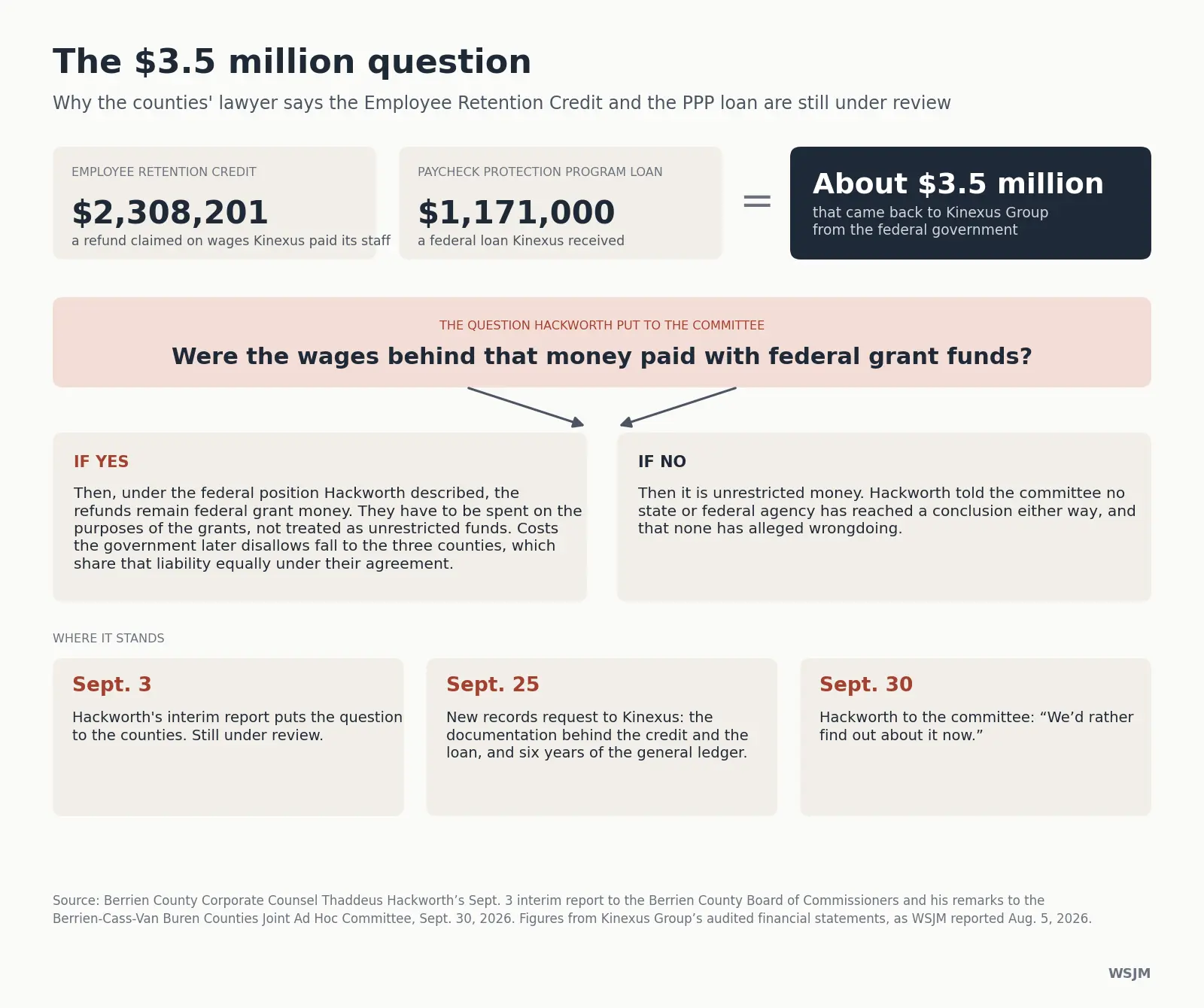
That last question, Hackworth said, is still under review, and related document requests to Kinexus are outstanding. It turns on the Employee Retention Credit and the Paycheck Protection Program loan, about $3.5 million combined, a $2,308,201 credit and a $1,171,000 loan, as WSJM reported in August, and on whether the wages behind them were paid with federal grant money. If they were, federal rules might treat the refunds as grant money that had to be spent on grant purposes, not as unrestricted funds. Last Friday, Sept. 25, Hackworth sent Kinexus a new records request for the documentation behind both, along with six years of the organization’s general ledger.
Hackworth also described the state’s silence. When county representatives met with the Michigan Department of Labor and Economic Opportunity on Sept. 14, Hackworth asked, and repeated in writing that afternoon, whether the department considers the structure compliant with federal and state workforce law and, if not, what corrective action it expects. The department acknowledged the question on Sept. 18. “As of this meeting, 16 days have passed,” Hackworth said. What the department said on Sept. 14 is hard to reconcile, he added: it called Kinexus and the workforce development board separate entities, yet it accepts Kinexus’s bylaws as the board’s bylaws.
The search for a new WDB executive director
As the county representatives began the work of thinking through the future structure of workforce development work in Berrien, Cass, and Van Buren counties, Commissioner Marchetti asked a real-time question directly: “Who’s running the show now?”
“As of today, there is no executive director, there is no interim executive director,” Hackworth said. “I can’t tell you who’s calling the shots on a daily basis.”
Marchetti sits, with Van Buren County Commissioner Tina Leary, on the search committee the Kinexus board created Sept. 1 to find one. The two of them volunteered, she said, heard nothing for “several weeks,” were then told they had been appointed, then received an email from Dr. Ken Flowers, president of Lake Michigan College and a Workforce Development Board member, saying he was the chair, and then learned the position had been posted.
“In my world, the committee would have chosen the chair,” Marchetti said, and “the committee would have authorized the posting.”
Marchetti said the agency’s human resources officer should assist the committee, not sit on it, she said: “I don’t believe that that person should be on the committee, because she’s staff.” She added that the posting had been on the Kinexus website and “is not on the website anymore,” she said, though it remained on a job-listing site. The committee has not yet met, but is expected to meet next week.
“If people are going to continue to make [unauthorized] decisions, there is no hope for this organization,” Marchetti said. “This cannot go on: people making decisions that do not actually have the authority to make decisions.”
Hackworth recommended three interim conditions the counties could put in writing: no permanent appointment to the agency’s executive leadership without county and Chief Elected Officials Board approval; no sale or transfer of affiliates or lines of business without county approval; and continued access to records and audits. Berrien County Commissioner Robert Harrison asked for a public statement from the committee and a communication to Kinexus employees. County staff committed to preparing the statement and conditions letter.
A new public board
Hackworth said he expected no decision on structure Wednesday, and that he could speak to what the law requires but not to how a workforce board should best operate; he urged the committee to seek outside expertise.
“It’s clear at this point that there does need to be a new governance structure,” Hackworth said. Every other Michigan workforce area has settled who its workforce development board is by creating a new public entity, he said, “and not appointing a pre-existing nonprofit corporation.”
“In my view, every avenue moving forward begins with the creation of a public entity,” Hackworth said.
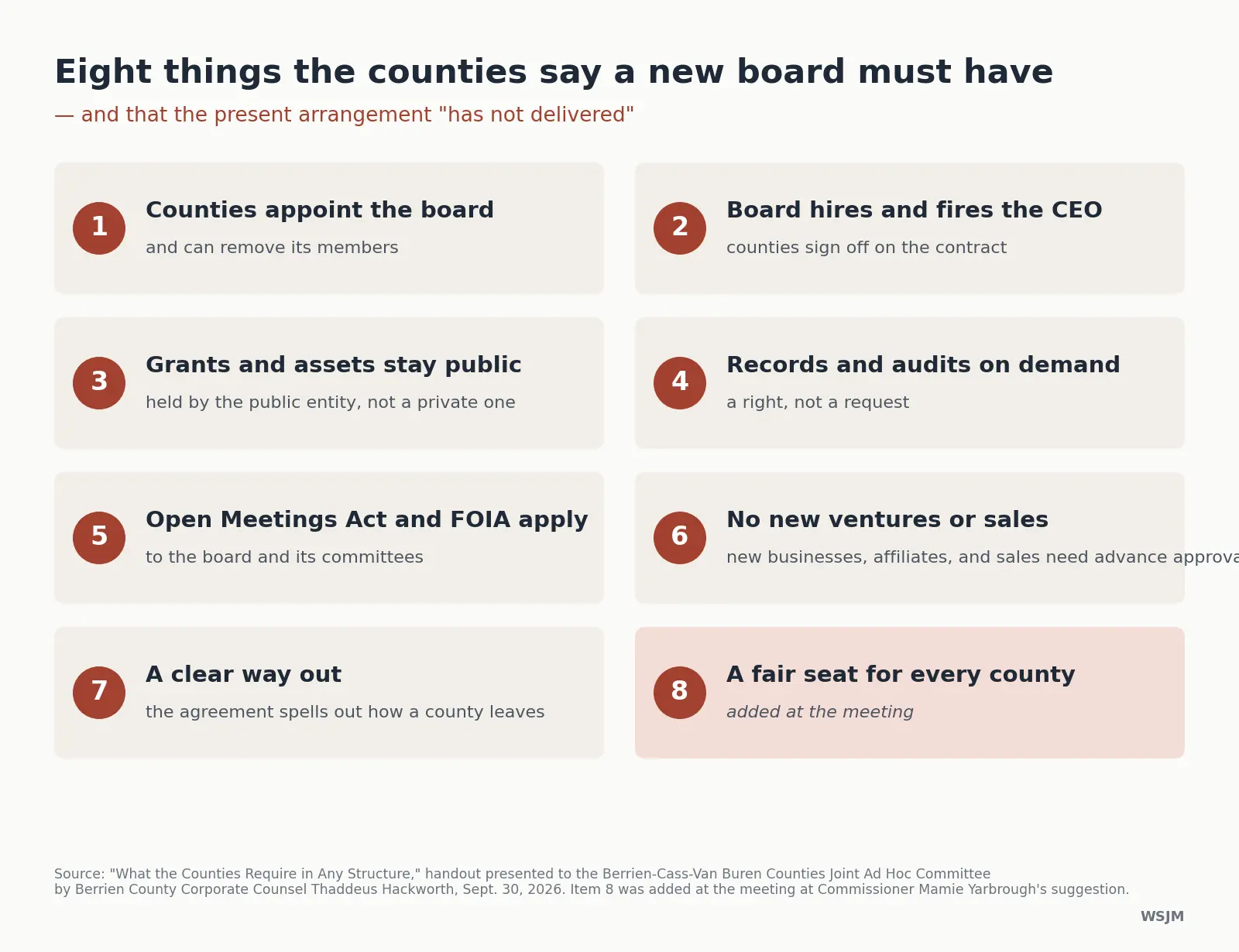
He gave the committee a one-page list of what the counties should require of any new structure, things the handout says the present arrangement “has not delivered.” In short: the counties appoint and can remove the board’s members; the board hires and can remove the chief executive, with county concurrence on the contract; grants and assets stay in public hands; the counties get records and audit access as a right; the Open Meetings Act and FOIA apply; new businesses, affiliates, and sales need advance approval; and the agreement spells out how a county leaves. At Berrien County Commissioner Mamie Yarbrough’s suggestion, he added fair representation of each county on the new board.
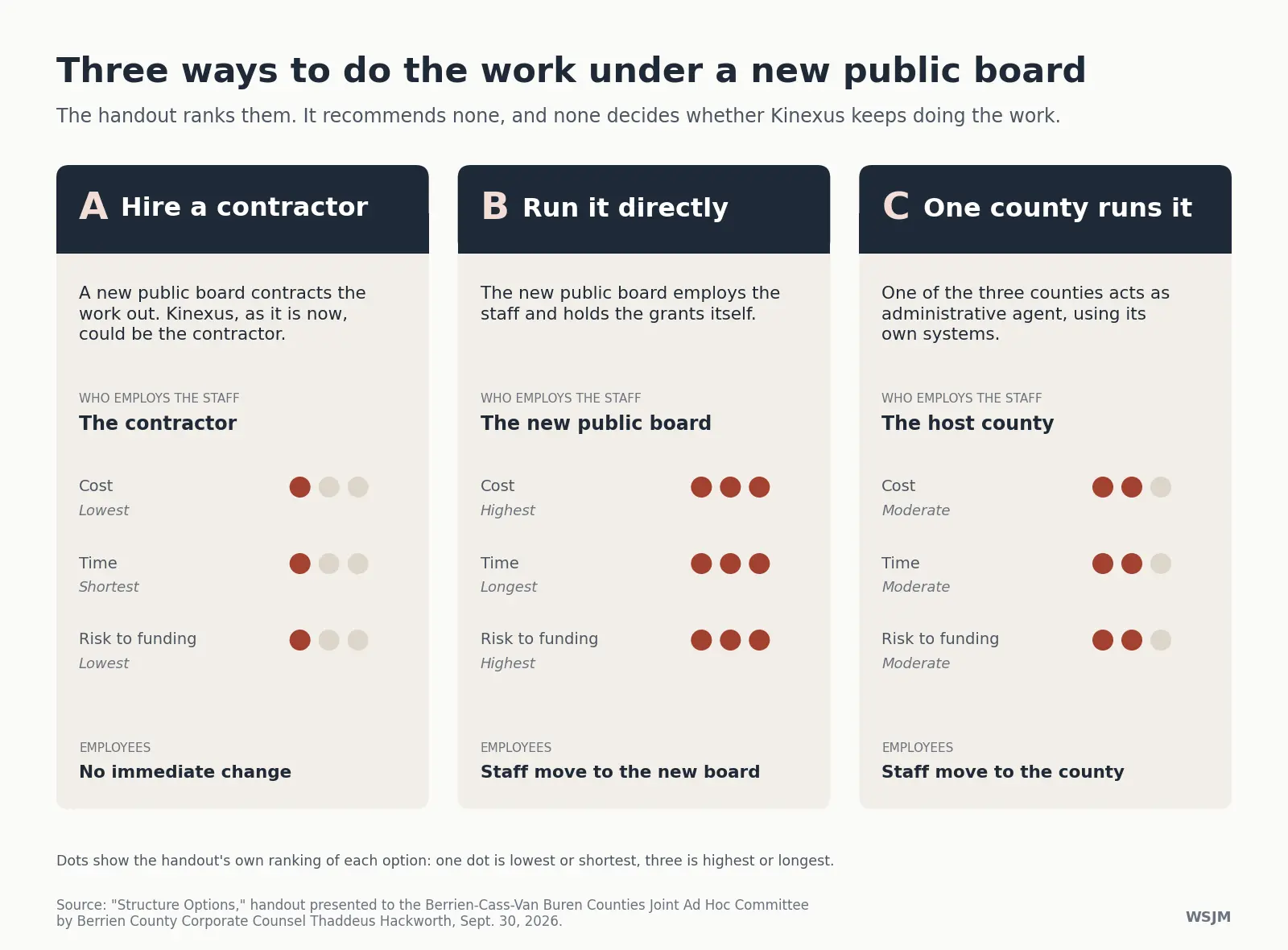
A second handout laid out three ways the work could be done under a new public board: contract it to an administrative entity, which could be Kinexus as it exists now; have the new public board employ the staff and hold the grants itself; or make one of the three counties the administrative agent. The handout ranks them on cost, start-up time, risk to funding, and effect on employees, recommends none, and notes that none of the three “decides whether Kinexus continues to do the work.”
Marchetti said she did not want the new agreement to carry the current one’s equal sharing of liability for disallowed costs; Cass County, she said, had “gotten the short end of the stick” on services for a long time. Hackworth said equal liability might be required by law and suggested the counties fix service delivery on the front end instead.
Van Buren County Commissioner Paul Schincariol asked whether it was accurate that no state or federal agency has alleged wrongdoing by Kinexus. Hackworth said none had; audits and monitoring reports had produced only minor findings. The liability concern is the Employee Retention Credit and the PPP loan, he said, no agency has reached a conclusion on them, and “we’d rather find out about it now.”
Van Buren County Board Chairman Kurt Doroh read an email from Van Buren County Administrator John Faul describing a conversation with Jakki Bungart-Bibb, director of Michigan Works! Southwest, which serves Branch, Calhoun, Kalamazoo, and St. Joseph counties, on how that agency is structured, with Kalamazoo County as the lead and the W.E. Upjohn Institute as fiscal agent employing the director. Faul wrote that Bungart-Bibb offered to help, including with an “executive on loan” to serve as director of Kinexus or of the workforce development board.
“In no way am I saying I want Kalamazoo to come in and take over,” Doroh said. “This is just informational.”
Yarbrough, who sits on the Chief Elected Officials Board and whom Berrien County has since added as its fourth member of the committee, said Kinexus board members “are dropping out,” with “a tremendous amount of people that have resigned from the board,” and asked for a communication to the members the counties appointed. Doroh said his board appointed three new members to the Kinexus board at its last meeting.
Committee members took assignments to gather information from the Michigan Works! Association, from Michigan Works! Southwest, and from commissioners in counties that use different models; Marchetti, Doroh, and Berrien County Commissioner Julie Wuerfel will handle contact with the state.
Doroh added two items to the agenda at the outset, the removal of Market One and of Kinexus Youth Solutions from Kinexus. After Hackworth said the no-sale recommendation in his report was aimed at Kinexus HR and not at those two affiliates, the committee voted on a roll call that it “does not oppose the plan for Market One to separate from Kinexus.” It took no action on Youth Solutions. WSJM will report on Market One’s plans separately.
After the meeting
Asked whether he could see Kinexus still running workforce development in the future, Doroh, Van Buren County’s board chairman, said: “It’s possible.” Requests for proposals could go out, he said, and Kinexus could respond. “Now that we’ve met, as three representatives from each county, we need to choose how to move forward,” he said, “and, as they say, get it done. Because it’s going on long enough.”
Harrison, of Berrien County, said “the way forward for the three counties working together was identified… We’re trying to understand the full complexity of the workforce development system and structures,” he said, “and try and pick the best path forward for the three counties.” Asked for a realistic timeframe: “That’s very hard to say. I don’t know.”
Marchetti, of Cass County, said the three counties’ commissioners “were on the same page” and that the meeting “has set us up for our next meeting, that we’ll really be able to make some strong decisions.” Asked whether the result would look drastically different from today, she said in one way it would, “but I don’t want to lose what we have and what we’ve done. [Kinexus board chairman] George Saleeby was right. We’ve done a lot of good things.” Whatever the counties do, she said, “I would like it to be as non-disruptive as possible.”
Board chairs: Kinexus lost focus, made poor leadership decisions
The Kinexus board’s outgoing chairman and a past chairman spoke during the public comment portion of the meeting. Saleeby, who said Wednesday was the last day of his term, read a statement from Luke Barber, the vice chairman he said is the incoming chairman. According to Saleeby, Barber wrote that the governance structure needs to change, that “Kinexus lost sight of its core mission,” and, on the ERC, “I do not disagree that those may not have been unrestricted funds,” a question for “the appropriate experts.” The best path, Barber wrote, is a newly structured workforce development board and interlocal agreement “while allowing Kinexus to continue serving as the administrative organization,” with Kinexus working “toward an orderly and planned spin-out or winding down” of unrelated subsidiaries.
Saleeby, for himself, said the organization had “done a lot of good work” and that he was proud of his years on the board, “no matter what is discovered.”
Arnie Redsicker, a past chairman, said he was proud of the work but that “it’s just a shame that we can get so far off base with some poor leadership decisions.”
The committee meets next on Friday, Oct. 16, at 10 a.m. in the Berrien County commission chambers, 701 Main St., St. Joseph, after the Kinexus board’s annual meeting that morning.
—
A note on methods: This series draws on thousands of pages of records — board minutes, audits, tax returns, and governing documents. WSJM used artificial intelligence tools to assist in searching, organizing, and cross-referencing those records and in preparing working analyses of them. Consistent with Associated Press guidance, WSJM treats AI output as unvetted source material: every fact that appears in these reports was verified by WSJM journalists against the original documents, all interviews and editorial decisions are human, and responsibility for the reporting rests entirely with the WSJM newsroom. Errors, when identified, are corrected and disclosed.