

Second in a series. WSJM is examining the inquiry by Berrien, Cass, and Van Buren counties into the Berrien-Cass-Van Buren Workforce Development Board, which does business as the Kinexus Group and runs the Michigan Works! offices in Benton Harbor, Cassopolis, and Paw Paw. On June 29, the counties’ corporate counsel asked the agency for records showing how it is governed. Kinexus produced 467 pages on July 20. This report is drawn largely from those documents.
Update, Aug. 12: The six written proxy appointments from Dec. 21, 2023 were included in the records Kinexus produced on Aug. 4.
The board that oversees federal job training money for Berrien, Cass, and Van Buren counties met on the Thursday afternoon before Christmas 2023.
It was a special meeting, set to start at 4 p.m. The minutes record that “notice of the meeting was waived by all present directors.” The board went into closed session at 4:05 p.m., came back into open session at 5 p.m., and in the next ten minutes voted to create a private for-profit company, buy a Grand Rapids human resources firm, borrow up to $1,125,000 to pay for it, seat four people on the new company’s board — including the chief executive who brought the deal forward — take out life insurance on three of its own executives, and open a $250,000 line of credit.
The meeting adjourned at 5:10.
Six of the votes on every one of those motions were proxies, cast for people who were not in the room. Just eleven months earlier, the board’s own rules had forbidden that outright.
Berrien, Cass, and Van Buren counties created this board. They appoint its members. Under federal law, they answer for the money it spends. But at that meeting, three of the counties’ six representatives were absent. It was, after all, a special meeting called on a Thursday afternoon four days before Christmas.
What the proxies did, and didn’t, do
The meeting minutes list twenty directors that day; fourteen present, six absent. Under the bylaws, a quorum is a majority of directors then in office — eleven. The board had a quorum without a single proxy, and the minutes record every motion as carrying unanimously.
Strike all six proxies and every decision made that afternoon still passes.
The question is not whether the votes would have come out differently. It is whether the proxy votes should have been cast at all, and by whom.
One of the six was a Cass County commissioner at the time who sat on the Chief Elected Officials Board, the panel of county officials charged with overseeing the agency. He spoke to WSJM on the condition that his name not be attached to his remarks. He says he would not have voted for the deal.
“Sheer cost,” he said. “It’s completely (the) polar opposite of what a not-for-profit is supposed to be doing.” – Cass County representative.
He had raised it before, he said. “My big question was why is a not-for-profit purchasing a for-profit business?”
The rule change
From 2018 until the amendment, the bylaws did not simply omit proxy voting. They banned it.
Section 3.10 read: “Voting by Directors by proxies shall not be permitted. An absentee Director may not delegate any duties to proxies or alternates.”
At the board’s March 3, 2023 meeting however, chief executive Todd Gustafson reported that the U.S. Department of Labor had been conducting a monitoring review, had pulled the agency’s governance documents, and had come back with two findings. One was that the agency lacked an operating agreement for its Chief Elected Officials Board. The other, as the minutes put it, was that the bylaws “do not include a proxy and alternative designee process.”
Gustafson and staff worked on the fix with the agency’s outside counsel, Mark Rizik of Miller Johnson. Gustafson said both documents went back to the Labor Department.
So there was a federal reason to change the rule. What the minutes also record is that the Kinexus leader knew he was changing the rule out of order, and said so.
“Mr. Gustafson commented that the process of approval for the By-Law Amendment (Proxy) request normally is submitted to the KG Board of Directors for review and approval then to the CEOs; however, due to the response timeline to USDOL, the CEO Board was requested to review, approve, and submit the recommendation to USDOL.”
The Chief Elected Officials signed the amendment on January 23, 2023, and made it effective that day. The board of directors did not vote until March 3, six weeks later, and its vote was retroactive.
Which body should have gone first is not a simple question. Kinexus’s own bylaws, at Section 11.01, give the power to amend to “a majority of the Directors then in office.” The federal regulation points the other way — it says the chief elected officials “must establish by-laws” for a local workforce board. But Section 11.01 adds a requirement that no amendment takes effect until all three county boards ratify it.
What the federal rule actually asks for
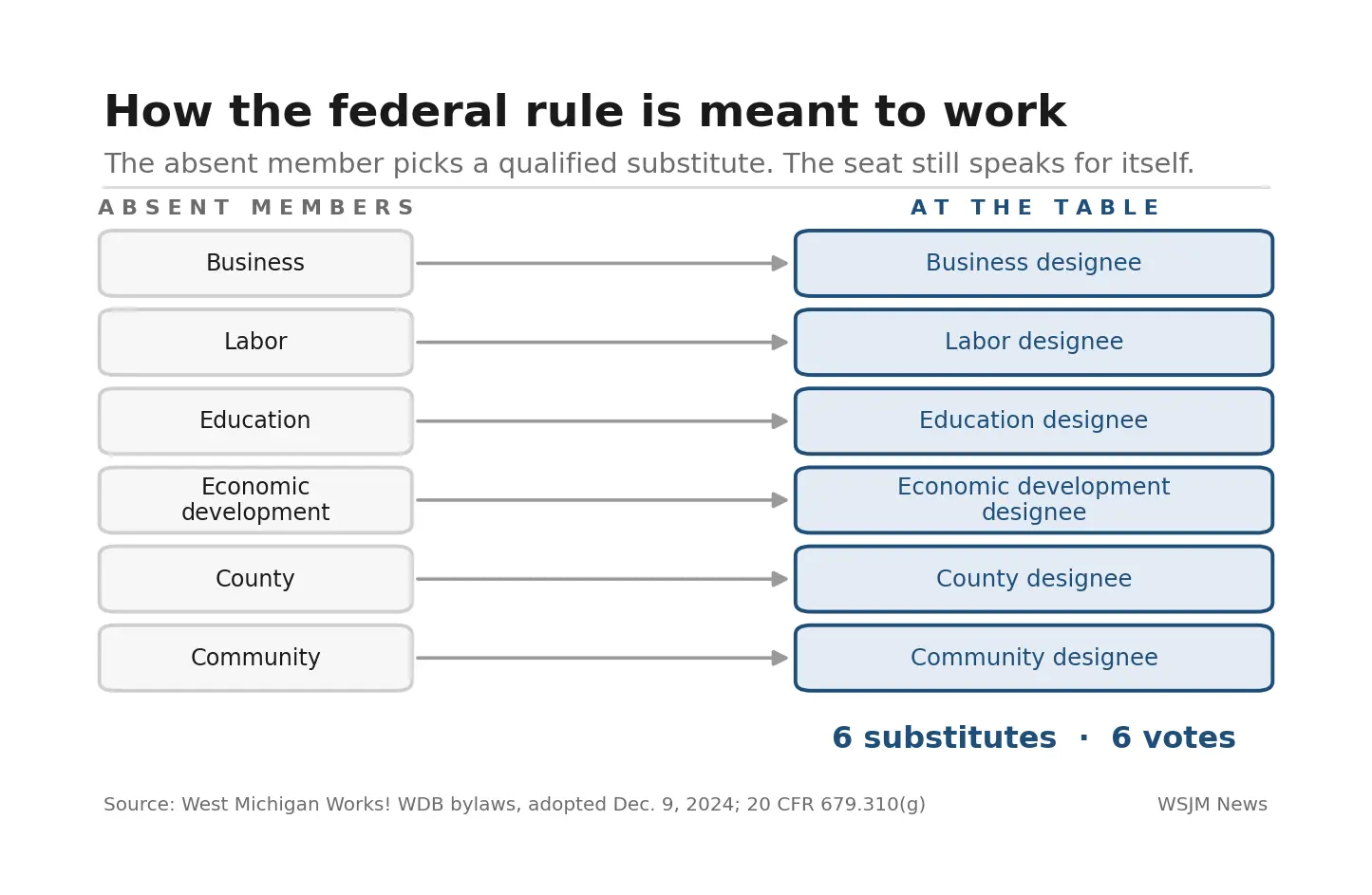
The requirement Gustafson described comes from the Code of Federal Regulations that lists what a local workforce board’s bylaws must cover. One item is “the proxy and alternative designee process that will be used when a WDB member is unable to attend a meeting and assigns a designee.”
The structure is a substitution. A seat on a workforce board exists to represent something — a business, a labor organization, a community college, a county. When the person holding that seat cannot attend, the rule contemplates that the member sends someone who can speak for the same interest.
 What Kinexus wrote instead
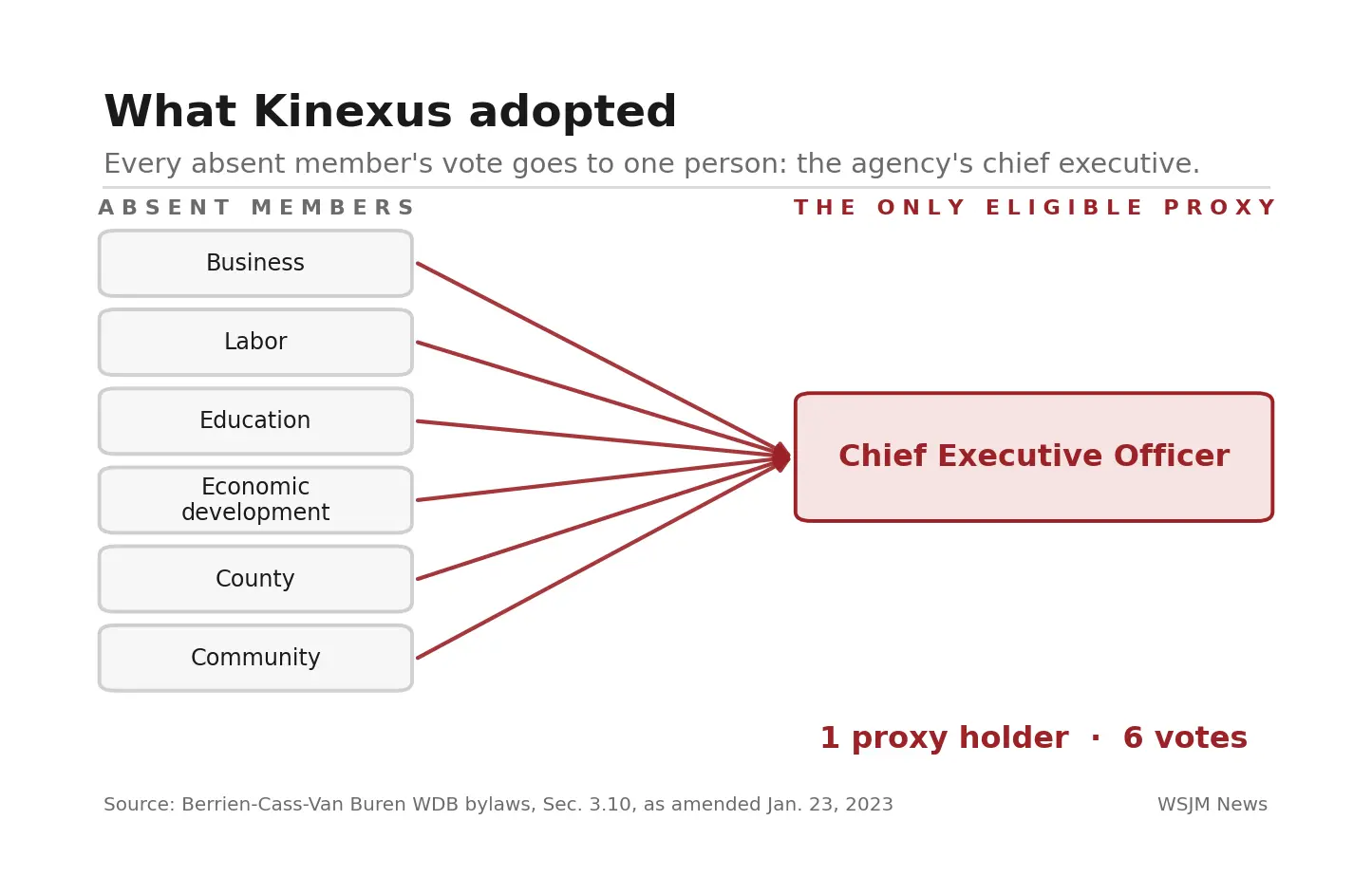
The amended Section 3.10 does not create designees. It creates a single proxy holder.
“An absent Director or other Director choosing to vote by proxy may, by written proxy, appoint the WDB’s Chief Executive Officer (‘CEO’) as the Director’s proxy. The CEO, as proxy, will have all of the authority of the appointing Director with respect to the matter(s) for which the Director has appointed the CEO as the Director’s proxy, except as otherwise limited by the appointing Director.”
Under that rule, an absent director cannot send a substitute from their own organization. The only person who may carry an absent director’s vote is the agency’s own chief executive — the employee whose work the board exists to oversee.
The rule sets three further conditions. Proxies must be in writing. They must be “presented to the person presiding over the meeting” before the proxy votes. And “the secretary for each meeting will maintain copies of all proxies for that meeting.”
WSJM asked Kinexus for the six from December 21, 2023. The organization has not provided them. No written proxy appointment appears anywhere in the 467 pages Kinexus has, so far, turned over to the counties.
 What another Michigan board did with the same problem
West Michigan Works! runs the job training system for Kent, Ottawa, Allegan, Barry, Ionia, Montcalm, and Muskegon counties. Federal reviewers spent four days going through its programs in late June 2024. On August 7, the finding came back: the board’s bylaws “did not include a proxy and alternative designee process that will be used when an LWDB member is unable to attend a meeting and assigns a designee.”
Its bylaws had said, “No proxies or substitutes shall be permitted.”
Nearly the same sentence Kinexus’s bylaws had carried since 2018. Two Michigan workforce boards, the same outright ban, the same federal finding.
The finding noted this was not new. Federal monitors had flagged the same gap in a report dated November 30, 2018, and the board “subsequently made the specific determination to not provide a process to allow its members to attend meetings via a proxy or alternative designee.”
And the finding said what the requirement is for.
“It is important for local boards to formalize this process in the by-laws as this ensures that LWDB members can add value to meetings with stakeholders, education partners, and employers and participate in decision making and strategy development of the LWDB.”
The purpose, in the department’s own words, is to get board members — or someone qualified to speak for them — into the room.
The two agencies did not fix it the same way.
On December 9, 2024, the West Michigan Works! board struck that sentence and put a process in its place that followed the substitute representative structure.
The member notifies the board chair in writing by noon, two business days ahead, naming the person and explaining how they qualify. The chair decides whether to accept. And the substitute may act for the member only “to the extent allowable under Michigan’s Open Meetings Act.”
The Kinexus rule has none of that. No qualification test. No advance notice — its proxies need only be presented at the start of the meeting, or as soon after as is practicable. No review by the chairman. No mention of the Open Meetings Act. And no choice about who the proxy is.
While West Michigan Works! allows for a qualified substitute, Kinexus routes every absent member’s vote to its chief executive, Todd Gustafson.
A designee under the West Michigan Works! rule sits at the table and speaks for the member who sent them. A proxy under the Kinexus rule puts no one in the room.
They also moved at different speeds. West Michigan Works! got its finding in August, took the language to a committee that fall, and had its board vote in December — with the rule taking effect on approval. The Kinexus rule took effect the day six commissioners signed it, six weeks before its own board voted.
The Christmas proxies
The minutes record the six as “yes proxy votes from Luke Barber, Ryan Laylin, Roseann Marchetti, Tom Stanek, Dan Wyant, and a proxy vote of yes from John Janick, who was present but left prior to the motion.” They attribute the votes to the absent individuals. They do not say who cast them.
Two of the six were not directors: the minutes list Laylin and Marchetti under “CEOB’s Absent,” a separate body, and the rule reaches only “an absent Director.” Three directors who were absent — Brady Cohen, Vicky Kruslemsky, and Trevor Kubatzke — had no proxy at all.
Under the rule the board had adopted eleven months earlier, only one person could have cast them.
If Gustafson cast them, the agency’s chief executive carried six votes on a resolution creating a company, and on the motion that seated him on its board. If he did not, the six were cast by someone the rule did not permit to hold a proxy at all.
WSJM asked Kinexus which it was. The organization has not answered.
Whether the rule ever took effect
For the amendment to actually take effect, it had to clear two requirements: notice and ratification.
Whether the notice requirement was met — whether directors were given the proposed amendment in advance — cannot be determined from the records Kinexus has produced.
The ratification requirement is a different matter. Section 11.01 is explicit: “In order to take effect, any amendments must also be ratified by the three (3) County Boards of Commissioners.”
Berrien County has certified that it never happened.
Responding to a Freedom of Information Act request from WSJM, Berrien County Corporate Counsel Thaddeus Hackworth wrote that “after a diligent search, no records responsive to your request were located,” and certified under Michigan law, MCL 15.235(5)(b), that no such records exist. The request had asked for any resolution or minute reflecting the county board ratifying a bylaws amendment in 2023 or 2024, and any correspondence from Kinexus or its lawyers asking the county to ratify one.
Neither exists. The county never voted on it. Nobody ever asked it to.
The resolution itself was signed by five commissioners acting as individual chief elected officials, among them Laylin and Berrien’s Julie Wuerfel, who began the counties’ inquiry. Under Section 11.01 that is not a county board voting to ratify — which is what Berrien certifies is missing.
WSJM asked officials in all three counties whether their boards ratified it. None provided an affirmative.
What Kinexus has said
Asked about the proxies and other matters related to the tri-county inquiry, Kinexus answered none of WSJM’s 21 written questions. Mark Rizik, the Grand Rapids attorney representing Kinexus, said the organization is “committed to transparency and to providing requested information through the appropriate procedures,” that counsel for both sides have agreed to procedures and an extended timeline, and that all requested documents will be produced by an agreed deadline. County officials say that the deadline is August 4.
“Many of the questions involve documents that have not yet been released or reviewed in their entirety,” he wrote. “It is important that any conclusions be based on complete information.” – attorney representing Kinexus.
The six written proxies from December 21, 2023 are among the documents WSJM has asked for. They have not been produced.
—
Next in this series: Money-and-disclosure.
—
Editor’s note: This report described the bylaws in effect before the January 2023 amendment as prohibiting proxy voting. Documents produced by Kinexus Group on Aug. 4 allow WSJM to specify the timeframe. A January 2023 board action item states that “In 2018, BCVB WDB took action” adopting the prohibition, which remained in effect until the 2023 amendment allowing proxies. Before the 2018 action, the bylaws did not address proxy voting — the version the three county boards ratified in 2015 titles Section 3.10 “Voting” and contains no proxy provision. WSJM has found no record that the 2018 addition or the 2023 amendment was ratified by the county boards of commissioners, as Section 11.01 of the ratified bylaws requires for amendments.